


Market Trends in 3 Minutes
April 7, 2026
NVDA Sideways as SpaceX Eyes $2T IPO Amid 75% AI Capex Surge
Executive Summary
AI Capex & Revenue Pivot: Hyperscalers face a "Netscape moment" with 75% YoY capex growth, shifting focus toward accelerating cloud revenue (AWS/GCP) and "agentic" AI monetization to justify massive infrastructure spend.
SpaceX & OpenAI Structural Shifts: SpaceX targets a historic $1.7T–$2T valuation for a June IPO driven by Starlink’s $20B revenue, while OpenAI signals a "New Deal" policy shift amid $2B monthly revenue and executive turnover.
Market Sentiment Divergence: Equities show resilience (Nasdaq +0.4% to +0.5%) despite geopolitical tension and "Mag 7" fatigue; retail engagement hit a 2022 low as investors rotate from high-beta tech to broad ETFs and semiconductors.
Corporate Dynamics
OpenAI: Transitioning to the "Social Contract" and Monthly Revenue Scaling
News: Chief Global Affairs Officer Chris Lehane proposed a "New Deal" featuring a Sovereign Wealth Fund (Alaska model) and "AI as a Right." Financials show growth from $1B/quarter in 2024 to $2B/month currently, following a $122B funding round.
Outlook: The shift toward business-focused AI via a new private equity joint venture under COO Brad Lightcap aims to stabilize revenue. However, internal friction regarding IPO timing and a strategic pivot away from Sora toward "Chat GPT-6" suggests a prioritized effort to maintain its competitive moat in LLM benchmarks.
SpaceX: The $2 Trillion Benchmark for the Space Economy
News: SpaceX is pitching a June IPO with a confidential S-1 filed, targeting a $1.7T to $2T+ valuation and seeking to raise $75B ($22B from retail). Starlink revenue is tracking toward $20B this year.
Outlook: While analysts view the valuation as a speculative bet not yet correlated to current revenue math, the successful IPO would trigger a sector-wide "re-rating." The transition from launch services to Starlink as a primary revenue driver fundamentally alters its long-term valuation logic from transportation to infrastructure.
Executive Summary
AI Capex & Revenue Pivot: Hyperscalers face a "Netscape moment" with 75% YoY capex growth, shifting focus toward accelerating cloud revenue (AWS/GCP) and "agentic" AI monetization to justify massive infrastructure spend.
SpaceX & OpenAI Structural Shifts: SpaceX targets a historic $1.7T–$2T valuation for a June IPO driven by Starlink’s $20B revenue, while OpenAI signals a "New Deal" policy shift amid $2B monthly revenue and executive turnover.
Market Sentiment Divergence: Equities show resilience (Nasdaq +0.4% to +0.5%) despite geopolitical tension and "Mag 7" fatigue; retail engagement hit a 2022 low as investors rotate from high-beta tech to broad ETFs and semiconductors.
Corporate Dynamics
OpenAI: Transitioning to the "Social Contract" and Monthly Revenue Scaling
News: Chief Global Affairs Officer Chris Lehane proposed a "New Deal" featuring a Sovereign Wealth Fund (Alaska model) and "AI as a Right." Financials show growth from $1B/quarter in 2024 to $2B/month currently, following a $122B funding round.
Outlook: The shift toward business-focused AI via a new private equity joint venture under COO Brad Lightcap aims to stabilize revenue. However, internal friction regarding IPO timing and a strategic pivot away from Sora toward "Chat GPT-6" suggests a prioritized effort to maintain its competitive moat in LLM benchmarks.
SpaceX: The $2 Trillion Benchmark for the Space Economy
News: SpaceX is pitching a June IPO with a confidential S-1 filed, targeting a $1.7T to $2T+ valuation and seeking to raise $75B ($22B from retail). Starlink revenue is tracking toward $20B this year.
Outlook: While analysts view the valuation as a speculative bet not yet correlated to current revenue math, the successful IPO would trigger a sector-wide "re-rating." The transition from launch services to Starlink as a primary revenue driver fundamentally alters its long-term valuation logic from transportation to infrastructure.
ORCL (Oracle): Industrializing Data Center Infrastructure
News: Appointed Hilary Maxson (ex-Schneider Electric) as CFO to manage tens of billions in data center development.
Outlook: Maxson’s background signals ORCL’s transition from a database-centric firm to an asset-heavy infrastructure provider. Revenue sustainability depends on its ability to execute this capital-intensive transition amid sector-wide valuation compression.
MU (Micron): Dominating the Memory Supply Constraint
News: Stock is up 32% YTD and 484% over the last year, with memory pricing expected to surge 30% to 50% due to shortages lasting through 2027/2028.
Outlook: As compute constraints shift to memory, MU is positioned for significant revenue acceleration. Its outperformance relative to NVDA suggests a "catch-up trade" where memory becomes the primary bottleneck for AI scaling.
NVDA (Nvidia) & AVGO (Broadcom): Valuation Compression Amid Sideways Trading
News: Both leaders have traded sideways for eight months; NVDA is down 5% YTD and AVGO is down 9-10%, with valuations compressing to roughly 15x earnings.
Outlook: Despite leadership status, retail activity in NVDA is at multi-year lows. Revenue growth remains high, but the market is demanding evidence of broader AI application beyond initial chip sales to restore multiple expansion.
INTC (Intel): Government Subsidies vs. PC Market Headwinds
News: Stock up 37% YTD, supported by improved balance sheets and government investment.
Outlook: While federal backing provides a floor for valuation, potential downturns in the PC market pose a risk to core revenue streams, making its foundry transition critical for long-term growth sustainability.
MSFT (Microsoft): Rebounding from Deep Year-to-Date Lows
News: Shares were down 23–26% at their lowest point this year, though recently closing up 1%.
Outlook: MSFT remains a core "dip buyer" target for retail investors. Its growth trajectory is heavily tied to justifying its heavy capex through Copilot and Azure monetization.
TSLA (Tesla): Retail Fatigue and Pricing Pressure
News: Down 22% YTD, hitting a six-month low.
Outlook: As a retail favorite, TSLA’s decline reflects broader "Mag 7" fatigue. Revenue growth is pressured by competitive pricing and a lack of new near-term catalysts, impacting its premium valuation moat.
AMZN (Amazon) (AWS) & GOOGL (Google) (GCP): The Cloud Growth Mandate
News: AWS expectations for Q1 are near 30% growth (up from 24%); GOOGL GCP is also expected to show "serious acceleration".
Outlook: These hyperscalers must demonstrate that 60-80% increases in 2026 capex plans are yielding direct revenue acceleration in cloud services to prevent further downward revisions to free cash flow.
Anthropic: Carving a Developer Moat
News: Gaining traction with "Claude Code".
Outlook: Analysts suggest Anthropic has found a distinct moat in utility/coding tools, providing a specialized revenue path separate from the general-purpose LLM arms race.
QCOM (Qualcomm) & LITE (Lumentum): Cost Pressures and Underperformance
News: QCOM was downgraded due to rising DRAM costs; **LITE dropped 6% in recent trading.
Outlook: Rising component costs for RAM are expected to pressure smartphone and PC margins, threatening QCOM’s revenue trajectory in the consumer hardware segment.
V (Visa): The Facilitator of AI Commerce
News: Report shows 40% of Americans use AI for purchases; 53% would allow AI-to-AI negotiation.
Outlook: V is positioning itself to capture "bot-to-bot" transaction volume, a structural shift that could disintermediate traditional sales roles but create a new high-frequency revenue stream for payment processors.
Industry Trends
The AI Capex-to-ROI Bridge
Analysis: The industry is navigating a massive spending wave, with capex up 75% in 2025 and another 75% projected for 2026. This "asset-heavy" shift has caused four consecutive quarters of downward revisions for free cash flow as investors wait for monetization.
Outlook: Success depends on "Agentic AI" adoption and cloud revenue acceleration. If AWS and Google cannot hit the ~30% growth mark, the "too hard" bucket for software valuation will likely expand.
The "Netscape Moment" and IPO Pipeline Re-Rating
Analysis: High-valuation filings from SpaceX ($2T target) and potential OpenAI movements are creating a benchmark moment. Simultaneously, tools like Perplexity are shifting the market toward "Mixture of Experts" models that aggregate various LLMs.
Outlook: This trend may disintermediate individual model providers, favoring platforms that offer the best "utility" outcome. Digital infrastructure is also expanding toward "orbital data centers," moving from speculative fiction to institutional consideration.
Autonomous Commerce and Bot-to-Bot Negotiation
Analysis: A generational shift (Gen Z/Millennials) is normalizing AI-influenced shopping. 88% of users trust AI with pricing/inventory data, signaling a move toward autonomous commerce where AI agents negotiate directly with each other.
Outlook: This will likely lead to significant layoffs in sales and middleman sectors, while favoring platforms that can integrate AI agents into the commerce chain.
Market Sentiment
Retail De-Risking and the ETF Rotation
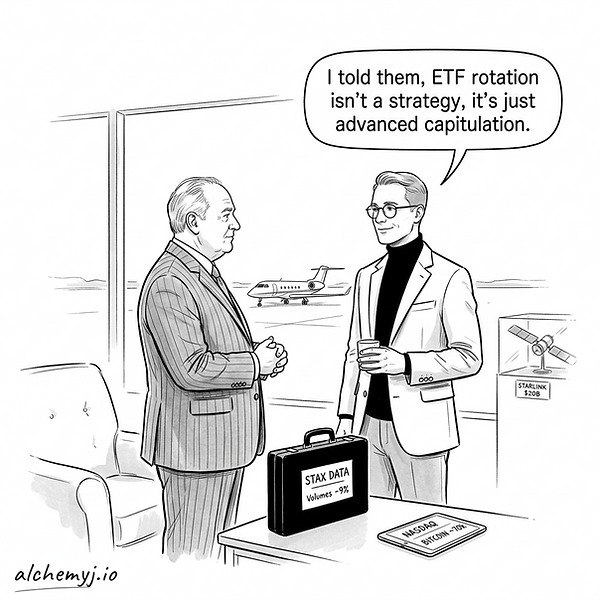
Analysis: Retail engagement has pulled back 2% according to STAX data, with trading volumes down 9% over five days—the lowest level since 2022. Investors are moving away from high-beta individual names like Nvidia and Tesla toward broad ETFs to mitigate volatility.
Outlook: Given the $2T loss in market cap for the "Mag 7" since all-time highs, retail sentiment is shifting from "aggressive call buying" to neutral "spread trading" and 0DTE options, indicating a "cautious optimism" rather than expectation of a massive breakout.
Geopolitical Resilience vs. "Rational" Ceasefire Skepticism
Analysis: Markets (Nasdaq +0.4%, Bitcoin ~$70,000) are currently brushing off Middle Eastern instability despite Iran’s rejection of ceasefire proposals and its "maximalist" demand for sovereignty over the Strait of Hormuz.
Outlook: With a Wednesday 8:00 p.m. ET deadline set by President Trump for an Iranian deal, the market is vulnerable to a "risk-off" shock if civilian infrastructure is targeted. Current resilience may be a "calm before the storm" scenario.
The "Too Hard" Bucket for Software
Analysis: JPMorgan’s Jamie Dimon noted the difficulty in discerning clear winners in AI, leading to valuation compression across the software sector. This is reflected in the "lackluster" performance of software sub-sectors compared to semiconductors like Micron.
Outlook: Sentiment remains polarized; while AI is not viewed as a bubble, the "valuation gap" between hardware (chips/memory) and software (monetization) will likely persist until clear ROI evidence emerges from the enterprise sector.
Important Disclosure
This newsletter is for informational purposes only and does not constitute investment advice. Content is generated by AI and may contain inaccuracies; always verify data independently before trading. Investing involves significant risk of loss. AlchemyJ is not a registered financial advisor. By reading this, you agree to our terms.
