


Market Trends in 3 Minutes
April 24, 2026
AI Trade Diverges as Intel Gains and Software Leaders Sell Off
Executive Summary
Divergent AI Trade: Semiconductors extended record streaks behind Intel and SK Hynix, while software leaders like ServiceNow and IBM faced sharp selloffs despite growth, signaling investor skepticism regarding AI monetization timelines.
Tesla’s $25B Pivot: Tesla transitioned to an AI-first strategy, committing massive capex to Robotics and FSD, which pressures short-term free cash flow but targets vertical integration through the "Terrafab" chip project.
Infrastructure Lead: High demand for AI cooling and power, exemplified by Vertiv’s 30% revenue jump, confirms physical infrastructure as the current bottleneck and primary beneficiary of the AI compute build-out.
Workforce Realignment: Big Tech firms (Meta, Microsoft) are implementing aggressive layoffs and buyouts to offset a projected $650 billion in AI capital expenditures, prioritizing infrastructure over headcount.
Corporate Dynamics
TSLA (Tesla): High-Stakes AI and Robotics Transformation
News: Committed $25 billion in capex for the 2026 fiscal year—up from $11 billion in 2024—to fund the Robotaxi (Cybercab) and Optimus projects. Operating cash flow is projected at $15 billion against a $45 billion cash balance, though free cash flow will turn negative during this investment cycle. FSD subscribers reached 1.28 million.
Outlook: Revenue trajectory is now tethered to the successful scaling of non-automotive AI products. While negative free cash flow introduces near-term risk, the $3 billion "Terrafab" chip facility aims to lower unit costs and secure the supply chain, potentially strengthening the long-term competitive moat through vertical integration.
INTC (Intel): Foundry Gains via AI Vertical Integration
News: Shares rose following a Q1 earnings beat ($13.58B revenue vs. $12.36B estimate) and a surge of 15-16% in after-hours trading. The company is supporting TSLA’s "Terrafab" using its 14A process, signaling a win for its foundry business. Data Center/AI revenue reached $5.05B.
Outlook: Strong Q2 guidance ($13.8B–$14.8B) suggests Intel is successfully filling factory capacity with outside customers. Revenue growth is currently driven by an "agentic era" where AI agents increase CPU demand, though high memory prices may pressure the PC segment later this year.
Executive Summary
Divergent AI Trade: Semiconductors extended record streaks behind Intel and SK Hynix, while software leaders like ServiceNow and IBM faced sharp selloffs despite growth, signaling investor skepticism regarding AI monetization timelines.
Tesla’s $25B Pivot: Tesla transitioned to an AI-first strategy, committing massive capex to Robotics and FSD, which pressures short-term free cash flow but targets vertical integration through the "Terrafab" chip project.
Infrastructure Lead: High demand for AI cooling and power, exemplified by Vertiv’s 30% revenue jump, confirms physical infrastructure as the current bottleneck and primary beneficiary of the AI compute build-out.
Workforce Realignment: Big Tech firms (Meta, Microsoft) are implementing aggressive layoffs and buyouts to offset a projected $650 billion in AI capital expenditures, prioritizing infrastructure over headcount.
Corporate Dynamics
TSLA (Tesla): High-Stakes AI and Robotics Transformation
News: Committed $25 billion in capex for the 2026 fiscal year—up from $11 billion in 2024—to fund the Robotaxi (Cybercab) and Optimus projects. Operating cash flow is projected at $15 billion against a $45 billion cash balance, though free cash flow will turn negative during this investment cycle. FSD subscribers reached 1.28 million.
Outlook: Revenue trajectory is now tethered to the successful scaling of non-automotive AI products. While negative free cash flow introduces near-term risk, the $3 billion "Terrafab" chip facility aims to lower unit costs and secure the supply chain, potentially strengthening the long-term competitive moat through vertical integration.
INTC (Intel): Foundry Gains via AI Vertical Integration
News: Shares rose following a Q1 earnings beat ($13.58B revenue vs. $12.36B estimate) and a surge of 15-16% in after-hours trading. The company is supporting TSLA’s "Terrafab" using its 14A process, signaling a win for its foundry business. Data Center/AI revenue reached $5.05B.
Outlook: Strong Q2 guidance ($13.8B–$14.8B) suggests Intel is successfully filling factory capacity with outside customers. Revenue growth is currently driven by an "agentic era" where AI agents increase CPU demand, though high memory prices may pressure the PC segment later this year.
NOW (ServiceNow): Software Valuation Disconnect
News: Suffered its largest historical stock drop (down 17.6%) despite 22% subscription growth and a raised 2026 target of $1.5 billion for AI-specific contract value.
Outlook: The market reaction indicates a breakdown in the correlation between high growth and valuation. Despite being a $15 billion enterprise growing at 20%+, investors are discounting future pricing power, suggesting revenue sustainability is being questioned despite solid execution.
SK Hynix: Record Profits vs. Market Skepticism
News: Reported a fivefold jump in quarterly profit, leveraging a 60% market share in High Bandwidth Memory (HBM).
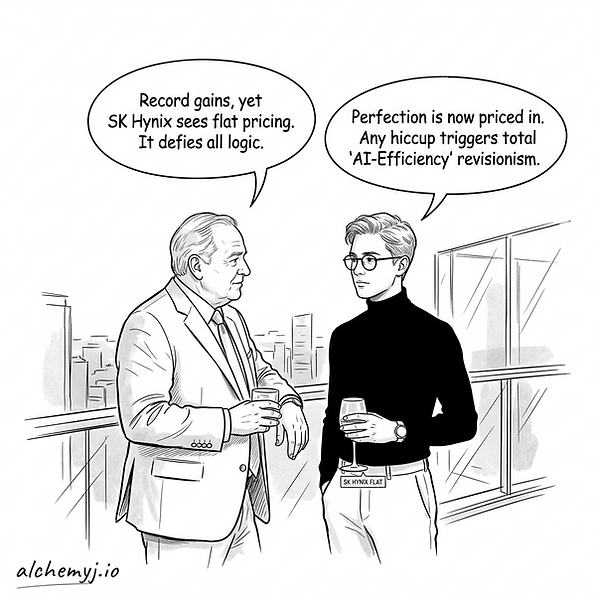
Outlook: While currently capturing massive revenue from the AI boom, flat share price performance suggests investors fear a peak in the memory cycle, questioning if high-margin HBM demand can sustain long-term growth.
TXN (Texas Instruments): Analog Demand Surge
News: Shares jumped 19% (best day since 2000) driven by demand for analog chips in data center industrial machinery.
Outlook: This indicates that the AI build-out is expanding beyond GPUs into general industrial and data center components, providing a diversified revenue stream that balances cyclicality in other segments.
IBM: Macro Uncertainty Weighing on Margins
News: Shares fell 8% after failing to upgrade full-year revenue guidance, citing "macroeconomic uncertainty" despite reporting improved margins and cash flow.
Outlook: Revenue growth remains stagnant as enterprise clients hesitate on large-scale software commitments, weakening IBM’s ability to prove its AI-driven turnaround is gaining top-line momentum.
MSFT (Microsoft): Strategic Reallocation of Human Capital
News: Offered voluntary buyouts to 7% of its U.S. workforce. Shares faced pressure as the company balances headcount costs against massive AI infrastructure spending.
Outlook: The shift suggests MSFT is sacrificing traditional software margins to fund its share of the $650 billion industry-wide AI capex. Future revenue growth is increasingly dependent on the ROI of these infrastructure investments rather than labor-intensive services.
LYFT: Aggressive London Expansion and Autonomous Pivot
News: Acquired Gett’s UK business to capture 75-80% of London’s black cabs. Concurrently launching autonomous Waymo vehicles in Nashville.
Outlook: Utilizing its $1 billion cash pile for acquisitions signals a shift toward global scale. The transition to autonomous fleets in Nashville suggests a long-term plan to replace variable driver costs with fixed technology costs, potentially expanding margins.
VRT (Vertiv): The AI Infrastructure "Coiled Spring"
News: Reported a 30% jump in revenue and raised full-year guidance. The stock has risen over 300% in 12 months.
Outlook: As a provider of power and cooling, VRT is in the "early innings" of AI compute capacity build-out. Its revenue trajectory appears more secure than software, as physical infrastructure is a mandatory prerequisite for AI deployment.
META (Meta): Efficiency-Driven AI Scaling
News: Planned layoffs of 10% (8,000 jobs) while projecting record spending on AI infrastructure and chips. Introduced "Insights Tab" for parental supervision of AI bots.
Outlook: Zuckerberg's "Year of Efficiency" continues to fuel revenue growth by cutting legacy costs to fund AI chips. The move into parental AI tools suggests a strategy to protect its competitive moat by addressing safety and "social media addiction" pressures.
SpaceX: Defense Integration and M&A Ambitions
News: Playing a central role in the $185 billion "Golden Dome" missile defense project; reportedly seeking to acquire Cursor AI for $60 billion for its XAI segment.
Outlook: By positioning itself as the "operating system" for national defense, SpaceX is diversifying revenue away from launch services toward high-margin government software and AI contracts.
PARA (Paramount) & WBD (Warner Bros. Discovery): Consolidation Amid Resistance
News: Shareholders approved a $110 billion acquisition of WBD by PARA (Paramount)/Skydance.
Outlook: The deal faces "antitrust nightmares" and creative opposition. If cleared, the merger aims for survival through scale, but the friction suggests potential disruptions to production and immediate revenue realization.
SONY: Physical AI Breakthroughs
News: Showcased a ping-pong robot that defeated highly ranked human players in 7 out of 13 games.
Outlook: While a "test case," it demonstrates advancements in computer vision that could eventually translate into revenue-generating industrial or consumer robotics applications.
LTK: Human Creator Resilience
News: Powered $6 billion in retail sales; reported a 20% rise in consumer trust for human creators over AI.
Outlook: Suggests a "human-in-the-loop" revenue model remains more viable for the creator economy than pure AI generation, providing a defensive moat against AI-generated content saturation.
Industry Trends
The Software-AI Divergence
Analysis: A "software AI scare" is driving a 6% sector decline (IGV ETF). Despite high subscription growth (ServiceNow at 22%), investors are "re-shorting" the sector. The logic is a fear that AI will disrupt traditional SaaS pricing power and that the ROI on enterprise software AI features remains unproven.
Outlook: Software firms must demonstrate clear "AI annual contract value" (ACV) to regain trust. Until then, capital is rotating out of software and into "proven" hardware winners.
Semiconductor Extension and the "Agentic Era"
Analysis: The SOX index is 42% above its 200-day moving average, a level not seen since 2000. Growth is fueled by the transition to "agentic AI," which shifts workloads from GPUs back to high-performance CPUs and specialized AI memory (HBM).
Outlook: Leaders like Nvidia (+$900B market cap) and Broadcom (+$600B) face high expectations. The trend favors companies like Intel and SK Hynix that can solve supply bottlenecks for these next-generation agents.
Data Center Power and Cooling Bottlenecks
Analysis: Revenue for infrastructure providers like Vertiv and Texas Instruments is surging because AI chips require unprecedented power and thermal management. This is described as a "coiled spring" of demand.
Outlook: Infrastructure will likely remain the most resilient AI trade. As long as the "Big Four" continue their $650 billion spending spree, the providers of the "shell" (power/cooling) face less disruption risk than the "content" (software) providers.
Market Sentiment
Contrarian Skepticism in the Midst of Record Gains
Analysis: Despite a 17-day winning streak in semiconductors and $3 trillion in added market cap, sentiment is turning cautious due to "extreme extension" relative to historical averages. Investors are questioning the longevity of the boom as companies like SK Hynix see flat pricing despite record profits.
Outlook: Given that the chip index is at dot-com peak levels of extension, the market is primed for a "perfection or bust" reaction to future earnings. Any technical hiccup in 14A architecture scaling or a cooling in HBM demand could trigger a rapid reversal.
The "AI-Efficiency" Paradox in Big Tech
Analysis: There is unanimous expectation that Big Tech must cut human labor (Meta 10%, Microsoft 7%) to fund AI infrastructure. However, the surge in AI-related abusive material (1.5 million reports) and investigative hurdles suggests a growing "hidden cost" of AI that could lead to future regulatory headwinds.
Outlook: Sentiment toward "AI for Efficiency" is positive for margins today, but the lack of upgraded guidance from IBM and the record software selloffs (ServiceNow) suggest the market is losing patience with "AI potential" and demanding immediate "AI profit."
Important Disclosure
This newsletter is for informational purposes only and does not constitute investment advice. Content is generated by AI and may contain inaccuracies; always verify data independently before trading. Investing involves significant risk of loss. AlchemyJ is not a registered financial advisor. By reading this, you agree to our terms.
