
June 30, 2026
Microsoft’s $570B Rout Highlights Tech Capex and Valuation Strain
RKLB, IRDM, AMZN, GOOGL, VZ, CMCSA, MSFT, BT, HIMS, BB
Executive Summary
Space and Satellite Consolidation: Rocket Lab’s $8 billion acquisition of Iridium establishes an integrated connectivity firm to challenge SpaceX’s L-orbit dominant footprint.
National AI Infrastructure Surge: South Korea's $880 billion initiative and record $251 billion Wall Street fundraising underscore massive, capex-heavy hardware and data center buildouts.
Frontier AI and Sovereign Controls: Anthropic secures restricted, highly vetted U.S. clearance for Mythos 5 amid escalating regulatory scrutiny over physical and frontier AI applications.
Macro Tech Capex Divergence: Tech equities rebound despite memory supply bottlenecks and investor concerns regarding long-term monetization horizons for rising capital expenditures.
Corporate Dynamics
RKLB (Rocket Lab): Vertical Space Integration via $8B Iridium Acquisition
News: RKLB agreed to acquire IRDM in an $8 billion cash and stock transaction at $54 per share, representing a 27% premium over the preceding Friday's closing price. The deal secures access to Iridium's resilient L-band spectrum and an operational 66-satellite low Earth orbit system. The acquisition will initially be financed via a debt bridge leveraging Rocket Lab's balance sheet and Iridium's cash-generative operations.
Outlook: This transaction immediately accelerates Rocket Lab's revenue potential by transforming it from a launch provider into an integrated connectivity firm, adding a lucrative applications layer and defense contracts. By controlling launch and spacecraft manufacturing internally—utilizing Electron and the upcoming Neutron system—Rocket Lab expects to eliminate major capital expenditures. However, long-term revenue growth sustainability depends on successfully ramping up the non-operational Neutron rocket to launch heavier communication payloads and fund expansion against SpaceX.
IRDM (Iridium Communications): Premium Exit Amid Intensifying Low Earth Orbit Competition
News: The satellite telephone pioneer agreed to be acquired by RKLB for $54 per share in an $8 billion transaction. The company's existing constellation maintains over a decade of operational life across maritime, aviation, and defense markets.
Outlook: The transaction validates IRDM's specialized spectrum and positioning, navigation, timing (PNT), and flight-tracking ("Aireon") assets. While its operational revenue is highly cash-generative, its standalone competitive moat faced long-term scaling constraints when measured against massive constellations like Starlink, making the Rocket Lab vertical merger a strategic necessity for survival.
Get instant access to AI-driven US tech market research.
Executive Summary
Space and Satellite Consolidation: Rocket Lab’s $8 billion acquisition of Iridium establishes an integrated connectivity firm to challenge SpaceX’s L-orbit dominant footprint.
National AI Infrastructure Surge: South Korea's $880 billion initiative and record $251 billion Wall Street fundraising underscore massive, capex-heavy hardware and data center buildouts.
Frontier AI and Sovereign Controls: Anthropic secures restricted, highly vetted U.S. clearance for Mythos 5 amid escalating regulatory scrutiny over physical and frontier AI applications.
Macro Tech Capex Divergence: Tech equities rebound despite memory supply bottlenecks and investor concerns regarding long-term monetization horizons for rising capital expenditures.
Corporate Dynamics
RKLB (Rocket Lab): Vertical Space Integration via $8B Iridium Acquisition
News: RKLB agreed to acquire IRDM in an $8 billion cash and stock transaction at $54 per share, representing a 27% premium over the preceding Friday's closing price. The deal secures access to Iridium's resilient L-band spectrum and an operational 66-satellite low Earth orbit system. The acquisition will initially be financed via a debt bridge leveraging Rocket Lab's balance sheet and Iridium's cash-generative operations.
Outlook: This transaction immediately accelerates Rocket Lab's revenue potential by transforming it from a launch provider into an integrated connectivity firm, adding a lucrative applications layer and defense contracts. By controlling launch and spacecraft manufacturing internally—utilizing Electron and the upcoming Neutron system—Rocket Lab expects to eliminate major capital expenditures. However, long-term revenue growth sustainability depends on successfully ramping up the non-operational Neutron rocket to launch heavier communication payloads and fund expansion against SpaceX.
IRDM (Iridium Communications): Premium Exit Amid Intensifying Low Earth Orbit Competition
News: The satellite telephone pioneer agreed to be acquired by RKLB for $54 per share in an $8 billion transaction. The company's existing constellation maintains over a decade of operational life across maritime, aviation, and defense markets.
Outlook: The transaction validates IRDM's specialized spectrum and positioning, navigation, timing (PNT), and flight-tracking ("Aireon") assets. While its operational revenue is highly cash-generative, its standalone competitive moat faced long-term scaling constraints when measured against massive constellations like Starlink, making the Rocket Lab vertical merger a strategic necessity for survival.
Samsung Electronics: Spearheading $518B Megadeal Domestic Production
News: Samsung Electronics, in partnership with SK Hynix, is slated to construct four chip fabrication plants (fabs) via a joint $518 billion project located in South Korea's southwest region.
Outlook: Driven by the national strategy to accelerate hardware buildout faster than regional rivals, the initiative directly targets doubling South Korea’s DRAM production capacity within five years. This massive manufacturing expansion secures Samsung's long-term revenue pipeline for AI-era hardware, though near-term free cash flows will be heavily pressured by the immense capital expenditure obligations.
SK Hynix: Dual-Track Domestic Fabs and Projected $30B U.S. IPO Pipeline
News: Alongside the $518 billion domestic fab initiative, SK Hynix is exploring a U.S. listing to execute a potential $30 billion fundraise expected in the coming weeks.
Outlook: Driven by the infrastructure needs of the AI boom, the potential U.S. listing aims to bridge SK Hynix's valuation gap with MU (Micron). The infusion of equity capital will fund intensive packaging and data center infrastructure, sustaining its competitive edge and supporting its revenue trajectory against memory supply chain bottlenecks.
SpaceX (SPCX): Dominant $251B Fundraising Pipeline and Record Derivatives Debut
News: SpaceX led a record $251 billion Wall Street fundraising surge via equity share sales. Concurrently, SpaceX options made an unprecedented secondary market debut, trading a record-breaking 1.88 million contracts on day one and briefly pushing its valuation to a spike of $220, surpassing AMZN (Amazon) in market cap before pulling back to a daily volume of 700,000 to 800,000 contracts.
Outlook: The massive capital influx reinforces SpaceX's dominant position and capital-intensive Starlink rollout. By utilizing equity issuance over traditional corporate debt, SpaceX preserves its balance sheet flexibility, strengthening its competitive moat and ensuring sustainable long-term infrastructure monetization.
GOOGL (Alphabet): Dow Jones Inclusion Amid At-The-Market Fundraising
News: GOOGL executed a blockbuster at-the-market (ATM) equity offering and made its debut in the Dow Jones Industrial Average, securing blue-chip designation and knocking VZ out of the index.
Outlook: The stock inclusion provides a symbolic cushion, though shares declined approximately 8% in June, pacing toward its worst month since last February. The ATM offering dilutes equity but guarantees non-debt capital to fund escalating AI data center capex, preserving its revenue moat against structural infrastructure shifts.
CyrusOne: Post-Holiday Equity Infrastructure Capitalization
News: Data center operator CyrusOne is set to kickstart its equity fundraising process following the Fourth of July holiday.
Outlook: Driven by the urgent corporate migration to AI infrastructure, CyrusOne's shift toward equity issuance rather than corporate debt will fund critical data center builds. This positioning secures long-term subscription and hosting revenue as enterprises rush to secure scarce data center space.
Cerebras: Strong $6B Valuation Debut
News: Cerebras executed a valuation debut north of $6 billion amid the broader AI infrastructure market boom.
Outlook: The multi-billion-dollar valuation reflects extreme market demand for alternative AI hardware. Sustaining this valuation and translating it into consistent revenue growth will require Cerebras to prove operational scale and bypass memory supply chain bottlenecks that favor entrenched mega-cap chipmakers.
Anthropic: Restricted Mythos 5 Restoration Under Strict Sovereign Controls
News: Anthropic secured conditional approval from the U.S. Department of Commerce to restore partial access to its frontier AI model, Mythos 5, which was abruptly halted two weeks prior on June 12th due to export controls and cybersecurity threats. The clearance restricts access exclusively to roughly 100 heavily vetted federal departments, agencies, and private firms.
Outlook: While the restriction limits immediate mass-market commercial revenue, it secures a highly sticky, high-margin sovereign institutional customer base. However, intense regulatory scrutiny and the complete omission of the Fable 5 variant from the clearance letter could slow down Anthropic's commercial commercialization velocity relative to unconstrained alternatives.
CMCSA (Comcast): Corporate Split and Strategic Infrastructure Focus
News: CMCSA shares rose 7% following the formal announcement of its plan to spin off NBCUniversal and Sky into a standalone media public entity, a transaction expected to take roughly one year.
Outlook: The corporate split isolates legacy media assets, leaving the parent company strictly focused on core broadband, wireless, and legacy cable infrastructure businesses. This structure provides enhanced strategic flexibility, optimizing infrastructure revenue stability and setting the stage for targeted M&A and consolidation within the cable media sector.
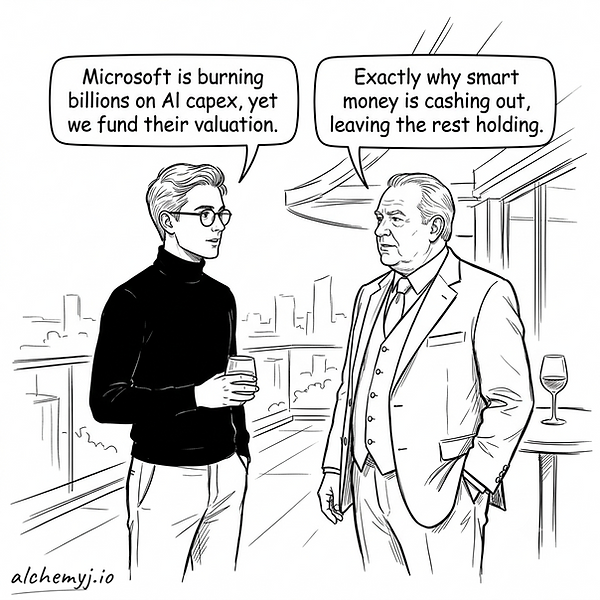
MSFT (Microsoft): Bullish Options Flow Confronts Worst Monthly Decline in 26 Years
News: MSFT shares dropped as much as 20% in June, shedding roughly $570 billion in market value and pacing toward its worst monthly performance in nearly 26 years. However, options market flow remained generally bullish, with buyers actively purchasing calls and selling puts.
Outlook: The disconnect between bullish options positioning and downward price action highlights underlying questions regarding Microsoft's long-term revenue positioning in a hyper-competitive AI landscape. Rising capex demands threaten near-term free cash flows, forcing Microsoft to demonstrate near-term commercial monetization to stabilize its valuation.
VZ (Verizon): $800M Projected Q2 Loss From BT Group Venture Merger
News: VZ expects a second-quarter loss ranging up to $800 million stemming from an agreement merging its international business with BT Group into a joint $4 billion venture. As part of the equalization terms, Verizon will make a direct payment of $625 million to BT Group. Concurrently, Verizon was removed from the Dow Jones Industrial Average.
Outlook: The immediate cash outflow and accounting loss compress near-term profitability. However, the $4 billion joint venture is designed to streamline international operations, potentially stabilizing long-term corporate enterprise revenue at the cost of immediate capital flexibility and index prestige.
BT Group: Equalization Inflow via Joint International Consolidation
News: BT Group entered a joint $4 billion venture merging its international business with VZ, securing a direct equalization payment of $625 million from Verizon.
Outlook: The cash infusion directly fortifies BT Group's balance sheet. By splitting operational overhead within a unified $4 billion structure, BT Group optimizes its international enterprise revenue potential while mitigating standalone operational risks.
Thrive Capital: Cultural Expansion via Thrive Eternal and Las Vegas NBA Bid
News: Thrive Capital founder Joshua Kushner, advised by former Disney CEO Bob Iger, is exploring a majority, controlling investment bid for an upcoming NBA expansion team in Las Vegas via "Thrive Eternal," a new investment vehicle targeting cultural assets, collectibles, and iconic franchises.
Outlook: Building on a smaller stake secured earlier this year in the San Francisco Giants, this expansion diversifies Thrive's portfolio into highly resilient live-entertainment assets. If approved by the NBA, the venture establishes a long-term premium sports media and entertainment revenue stream uncoupled from tech-sector valuation cycles.
Millennium Management: Internal Advanced Tech Lab Deployment
News: The hedge fund is launching a dedicated internal advanced artificial intelligence lab, scheduled to go live over the next few weeks.
Outlook: Providing early access to cutting-edge technological tools serves to optimize quantitative strategies and risk management parameters. This operational integration acts as a performance multiplier, driving asset management efficiency and protecting alpha generation from technological disruption.
HIMS (Hims & Hers): Direct-to-Consumer Digital Peptide Expansion
News: The company was identified by analysts as a primary logical beneficiary of the expanding direct-to-consumer digital health market for peptides focused on wellness, muscle recovery, and weight loss.
Outlook: Having already scaled subscription operations across hair loss, erectile dysfunction, dermatology, and GLP-1 weight loss, the company's marketplace is ideally positioned to integrate peptide distribution. This expansion offers a highly lucrative recurring revenue driver, though growth sustainability faces significant regulatory dependencies regarding upcoming FDA advisory committee actions.
BB (BlackBerry): Software Turnaround Accelerated by 26% QNX Embedded Growth
News: BB reported 26% growth in its QNX Embedded Software division, which currently powers over 275 million cars globally. The company's long-term royalty backlog has increased to $950 million.
Outlook: Driven by a strategic pivot away from legacy devices into embedded software and secure communications, BlackBerry's long design-to-production cycles yield a highly visible revenue mix: 20% upfront licensing, 20% services, and 60% ongoing royalties. Expansion into the general embedded market (GEM) and physical AI (robotics, medical instrumentation, automated mobile robots) secures an isolated, safety-certified competitive moat that protects future revenue streams from SaaS-style platform intermediation.
Industry Trends
The Macro Capex Dilemma: Valuation Compression vs. Infrastructure ROI
Analysis: Driven by the infrastructure demands of the global AI era, tech-heavy indices experienced a 2% rebound following sharp losses, even as memory supply chain bottlenecks drive up AI operational costs. U.S. fundraising reached a record $251 billion, indicating that companies are heavily favoring equity issuance over traditional corporate debt to fund data center builds. However, this massive capital expenditure expansion occurs alongside significantly declining free cash flows, sparking an intense market debate regarding corporate sustainability.
Outlook: Markets are aggressively rewarding tech capital expenditure recipients while penalizing the firms funding these multi-billion-dollar projects. Sustaining current valuations will require proven returns on investment over an explicit 3-to-10-year horizon. If clear monetization of AI technology is not achieved soon, investor willingness to accept rising capex may near its limit, prompting a structural slowdown in spending that could disproportionately impact overvalued tech stocks.
Physical AI and Open-Source Ecosystem Expansion
Analysis: Frontier AI labs face heavy, sovereign regulatory constraints, exemplified by the U.S. Department of Commerce restricting Anthropic's Mythos 5 access to heavily vetted entities. This regulatory pressure is shifting momentum toward open-source ecosystems and decentralized physical AI applications. Hugging Face reported over one million models and datasets shared last quarter alone, alongside shipping over 10,000 units of its open-source "LeRobot" robotics kit globally.
Outlook: Heavy regulatory frameworks create steep compliance barriers for frontier labs, yet open-source alternatives are increasingly competitive and vital for transparent physical AI applications like robotics, warehouse automation, and medical instrumentation. Smaller startups and universities that lack extensive legal infrastructure will rely on standardized architecture partnerships with hardware providers (Nvidia, Qualcomm, ARM) to bypass regulatory bottlenecks and scale decentralized autonomous machinery.
Automation Disruption and Workplace Friction
Analysis: Advanced AI tools are rapidly executing deep penetration into traditional white-collar and creative workflows. In corporate environments, transcription and summary bots from providers like Otter.ai and Read AI have reached millions of users, triggering friction regarding security, data retention, and interpersonal consent. Simultaneously, major Hollywood studios (Disney, DreamWorks, Netflix) are integrating AI automation directly into the animation pipeline.
Outlook: The economics of AI deployment are projected to slash animation production costs by 30% to 90%, offering media companies massive margin expansion. However, this shift threatens widespread job displacement and severe institutional friction. In corporate settings, security and retention concerns surrounding virtual notetakers will likely force rigid enterprise-wide data governance compliance protocols, tempering near-term software adoption rates.
Market Sentiment
The Capex Monopolization and Disconnect Risk
Analysis: Market sentiment presents a clear disconnect between speculative optimism and fundamental execution. While tech stocks have significantly outperformed their earnings momentum and options market flows for declining mega-caps like Microsoft remain stubbornly bullish, institutional asset managers are turning highly cautious. Equity issuance has hit an unprecedented $251 billion, indicating that firms are exhausting equity channels to fund cash-intensive infrastructure.
Outlook: Given the warning from investment advisors that quarterly earnings estimates are heavily reliant on volatile AI capex, market sentiment is approaching an inflection point. Savvy portfolio managers are advising a contrarian strategy: taking profits off the table for tech stocks showing inflated valuations and adopting a long-term portfolio rebalancing approach over short-term reactive trading.
Regulatory Gatekeeping and Startup Insulation
Analysis: A sharp divergence in sentiment exists regarding AI regulatory frameworks. While government transparency demands are viewed as reasonable for massive frontier labs due to cybersecurity threats, industry leaders strongly caution against allowing these heavy legal structures to bleed into smaller software ecosystems.
Outlook: Given the strict conditional restrictions placed on Anthropic's Mythos 5, sentiment indicates that open-source alternatives will gain a significant commercial edge. Investors are increasingly favoring physical AI and embedded software providers like BlackBerry's QNX, which hold long-term royalty backlogs ($950 million) and stringent industrial safety certifications, insulating them from both SaaS pricing compression and sovereign regulatory crackdowns.
Weekly In-Depth Analysis:
→ Read Weekly TechTrends:Microsoft's historic drop questions long-term tech software returns
Important Disclaimer
This newsletter is for informational purposes only and does not constitute investment advice. Content is generated by AI and may contain inaccuracies; always verify data independently before trading. Investing involves significant risk of loss. AlchemyJ is not a registered financial advisor. By reading this, you agree to our terms.
