
July 1, 2026
Nvidia and Microsoft Anchor Shifting Semiconductor and SaaS Valuations
NVDA, MU, SPCX, SMCI, AMD, MSFT, PLTR, CRM, AAPL, AMZN
Executive Summary
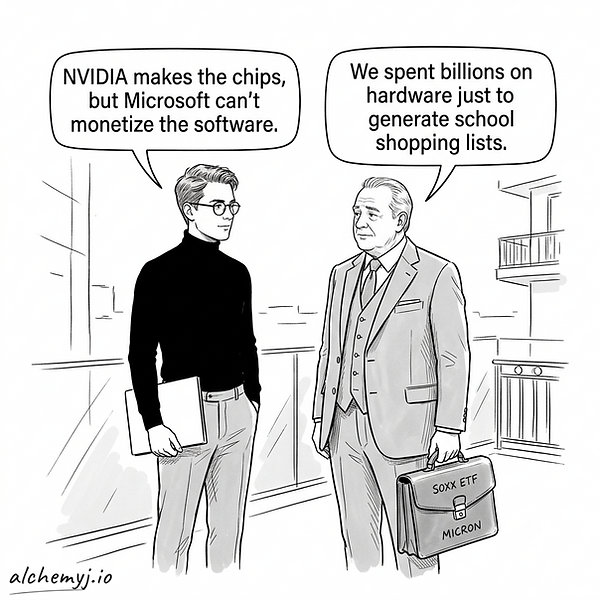
Semiconductor Surge vs. Software Disruption: The Philadelphia Semiconductor Index (SOX) and SOXX ETF surged 86% to 110% year-to-date, driven by unprecedented AI hardware and CPU demand. Conversely, mega-cap software faces an "AI-fueled SaaS apocalypse," causing Microsoft to suffer its worst monthly decline since 2000.
Infrastructure Bottlenecks and Supply Deficits: The AI buildout is transitioning from GPU compute toward severe memory, storage, and electricity bottlenecks. Micron and SK Hynix face extended under-supply through 2027–2030, commanding massive margin premiums.
Enterprise Shift to Efficiency: Cloud hyperscalers and enterprises are pivoting from "token maxing" model training to cost-efficient inference deployment. Hardware startup Etched emerged with an $800 million capital raise to challenge traditional architectures via cluster-scale, low-voltage inference.
Geopolitical and Labor Headwinds: Heightened US-China export controls are triggering global disruptions, highlighted by Taiwanese raids on Super Micro. Concurrently, domestic tech labor pipelines are constrained as entry-level visa sponsorships plummeted from over 10% to 2.3%.
Corporate Dynamics
NVDA (Nvidia): Massive Compute Dominance Confronts Rotational Volatility
News: NVDA shares are up approximately 7% this year, underperforming the broader SMH ETF which gained 80%. Despite printing incredibly strong earnings in the last quarter, the stock traded down. A significant portion of Etched's platform team, including the Vice President who ran the critical DGX and HGX platforms, was recruited from Nvidia.
Outlook: The near-term revenue trajectory remains robust, yet the immediate stock underperformance is driven by heavy institutional positioning and its utilization as a funding source for market rotations rather than a fundamental decay. Profitability models face long-term competitive pressure as the industry shifts focus from compute training to inference deployment, paired with talent attrition to emerging hardware startups.
MU (Micron): Astronomical Margin Growth Fueled by Extended Structural Deficits
News: MU reported stellar financial results, with shares climbing roughly 300% this year and more than 800% over the past 12 months. The company achieved an 85% gross margin—surpassing NVDA by 10 percentage points. Demand for its high-performance memory chips has completely sold out capacity through 2027.
Outlook: Revenue visibility is exceptionally high, with structural supply imbalances projected to sustain elevated growth into 2028 or potentially 2030. MU's pricing power enhances its competitive moat, though rising component costs are causing downstream pricing friction for major consumer tech hardware ecosystems.
Get instant access to AI-driven US tech market research.
Executive Summary
Semiconductor Surge vs. Software Disruption: The Philadelphia Semiconductor Index (SOX) and SOXX ETF surged 86% to 110% year-to-date, driven by unprecedented AI hardware and CPU demand. Conversely, mega-cap software faces an "AI-fueled SaaS apocalypse," causing Microsoft to suffer its worst monthly decline since 2000.
Infrastructure Bottlenecks and Supply Deficits: The AI buildout is transitioning from GPU compute toward severe memory, storage, and electricity bottlenecks. Micron and SK Hynix face extended under-supply through 2027–2030, commanding massive margin premiums.
Enterprise Shift to Efficiency: Cloud hyperscalers and enterprises are pivoting from "token maxing" model training to cost-efficient inference deployment. Hardware startup Etched emerged with an $800 million capital raise to challenge traditional architectures via cluster-scale, low-voltage inference.
Geopolitical and Labor Headwinds: Heightened US-China export controls are triggering global disruptions, highlighted by Taiwanese raids on Super Micro. Concurrently, domestic tech labor pipelines are constrained as entry-level visa sponsorships plummeted from over 10% to 2.3%.
Corporate Dynamics
NVDA (Nvidia): Massive Compute Dominance Confronts Rotational Volatility
News: NVDA shares are up approximately 7% this year, underperforming the broader SMH ETF which gained 80%. Despite printing incredibly strong earnings in the last quarter, the stock traded down. A significant portion of Etched's platform team, including the Vice President who ran the critical DGX and HGX platforms, was recruited from Nvidia.
Outlook: The near-term revenue trajectory remains robust, yet the immediate stock underperformance is driven by heavy institutional positioning and its utilization as a funding source for market rotations rather than a fundamental decay. Profitability models face long-term competitive pressure as the industry shifts focus from compute training to inference deployment, paired with talent attrition to emerging hardware startups.
MU (Micron): Astronomical Margin Growth Fueled by Extended Structural Deficits
News: MU reported stellar financial results, with shares climbing roughly 300% this year and more than 800% over the past 12 months. The company achieved an 85% gross margin—surpassing NVDA by 10 percentage points. Demand for its high-performance memory chips has completely sold out capacity through 2027.
Outlook: Revenue visibility is exceptionally high, with structural supply imbalances projected to sustain elevated growth into 2028 or potentially 2030. MU's pricing power enhances its competitive moat, though rising component costs are causing downstream pricing friction for major consumer tech hardware ecosystems.
Etched: Stealth Emergence and Radical Architectural Disruption in Inference
News: AI hardware startup Etched emerged from stealth after securing $800 million in funding at an estimated $5 billion valuation, backed by Jane Street and VentureTech Alliance. The company unveiled a pre-assembled, rack-scale inference system containing 32 proprietary first-generation chips optimized for cluster-scale memory and low-voltage inference.
Outlook: Etched is positioned to directly challenge GPU dominance in production environments by offering a superior dollar-per-token economic advantage. Operating at less than half the voltage of typical NVDA hardware bypasses traditional thermal throttling, drastically reducing power costs and accelerating revenue scaling as enterprises pivot toward cost-efficient inference.
SpaceX (SPCX): Retail Order Mismanagement Contrasts Explosive Core Revenue Vectors
News: A major operational misunderstanding left South Korean underwriter Mirae Asset Securities with zero stock allocation during SpaceX's massive IPO. Mirae aggregated $1 billion in retail demand but failed to submit an actual order book ahead of the June pricing dates. Concurrently, Bloomberg Intelligence models project SpaceX revenue could reach $160 billion by 2030, an 800% increase driven by xAI data center agreements utilizing Colossus 1 and 2.
Outlook: The core revenue trajectory is highly favorable, with xAI data center partnerships projected to swing the segment from a $5 billion loss into a $4 billion profit by 2030. However, the institutional blunder by Mirae has triggered regulatory investigations, and the company's premium valuation relative to established hyperscalers leaves it vulnerable to valuation corrections.
SMCI (Super Micro Computer): Geopolitical Enforcement Risks and Compliance Pressures
News: Taiwanese authorities raided the offices of SMCI, its distributor Albatron Technology, and Chief Telecom. The probe involves the residences of six individuals and investigates the alleged smuggling of Super Micro servers containing NVDA chips into China in violation of US export controls.
Outlook: While the alleged actions do not violate local Taiwanese laws, intensifying US pressure to criminalize high-end chip exports to China poses a material threat to SMCI's regulatory compliance and global distribution networks. Ongoing legal scrutiny could disrupt corporate operations and cloud hardware delivery pipelines, impacting near-term revenue sustainability.
SK Hynix: Capital Expansion and US Public Market Integration
News: SK Hynix commands an estimated 57% market share in high-bandwidth memory (HBM). To tap into broader international capital markets and fund domestic chip production capacity expansions, the company is planning a US listing for its American Depositary Receipts (ADRs).
Outlook: Revenue growth is heavily secured by the overarching structural supply-demand imbalance in high-performance storage. Access to US capital markets will allow SK Hynix to aggressively fund capex, reinforcing its dominant competitive moat against memory rivals.
AMD (Advanced Micro Devices): Accelerated CPU Target Revisions
News: AMD shares have gained over 170% since January. The stock experienced a significant upward pop following a WFC (Wells Fargo) price target revision from $505 to $615, driven by accelerating AI momentum and robust enterprise CPU demand.
Outlook: AMD's revenue expansion is heavily supported by broadening hardware diversification. As the market digests high valuations elsewhere, AMD's capacity to capture shifting CPU and AI infrastructure spend solidifies its position as a high-growth alternative in the semiconductor landscape.
MSFT (Microsoft): Enterprise Valuation Headwinds Amid Software Compression
News: MSFT suffered its worst month since the year 2000, with its stock declining over 20% year-to-date. The company is currently trading at roughly 19 times forward earnings. To compensate for macro inflationary pressures and rising memory costs, Microsoft raised retail pricing for its Xbox console.
Outlook: MSFT's software revenue trajectory faces intense scrutiny as investors worry that AI could erode its core software business. Furthermore, concerns persist regarding whether its capital expenditures are keeping pace with OpenAI, alongside evidence that Azure's growth is facing market share erosion from GOOG (Google) Cloud and emerging cloud platforms.
PLTR (Palantir): Enterprise Sales Imitation Amid Software Re-Valuation
News: Shares of PLTR have fallen over 30% since January, swept up in the broader deceleration affecting high-multiple software stocks. Structurally, its forward-deployed engineering model is now being emulated by cloud giants like AWS, which launched a $1 billion initiative to embed engineers directly into client sites.
Outlook: PLTR's specialized enterprise deployment moat is facing direct competitive encroachment from hyperscalers. While its core business model remains highly relevant for AI implementation, the stock contraction reflects severe compressed valuation logic as the market penalizes software firms lagging behind immediate hardware returns.
CRM (Salesforce): Sharp Multiple Contraction Under SaaS Apocalypse Fears
News: CRM shares plunged over 40% since the start of the year. The company has been severely impacted by institutional capital shifting away from mega-cap tech software names as investors rotate funds toward hardware infrastructure plays.
Outlook: Near-term revenue expansion is challenged by intense investor anxiety regarding an "AI-fueled SaaS apocalypse". The massive multiple contraction signals that long-term valuation logic is being recalibrated, requiring the company to prove that its software suite can generate tangible AI-driven ROI to restore historical growth premiums.
AAPL (Apple): Component Cost Inflation and Proactive Security Overhauls
News: Rising memory costs have driven AAPL to increase retail prices for its phones and iPads. Concurrently, Apple is actively lobbying US officials for special regulatory approval to procure memory chips from blacklisted Chinese manufacturer CXMT. Operationally, Apple altered its software deployment schedule to distribute security fixes immediately to combat AI-driven coding exploits.
Outlook: AAPL's hardware margins are under pressure from rising supply chain input costs. Its attempt to utilize blacklisted components faces severe bipartisan political pushback, with lawmakers warning it risks customer privacy, national security, and long-term shareholder value. Accelerated security patch cycles protect its ecosystem moat but underscore the rising operational costs of defending against AI vulnerabilities.
CMCSA (Comcast): Corporate Separation of Broadband and Legacy Media Portfolios
News: CMCSA announced a structural corporate spin-off, separating NBCUniversal and its European media unit, Sky, into standalone entities. The pivot follows a failed bidding war for WBD (Warner Brothers) and results in long-time Chairman and co-CEO Brian Roberts stepping down from his co-CEO role, though he will remain active.
Outlook: The strategic reorganization isolates CMCSA's high-margin broadband business, preventing weak legacy cable quarters from dragging down strong financial performance in theatrical box offices or theme parks. The creation of pure-play media and broadband entities aligns with current market preferences, protecting code revenue streams from conglomerate discount valuations.
AMZN (Amazon): Massive Forward-Deployed Enterprise AI Engineering Campaign
News: AMZN Web Services (AWS) launched a $1 billion forward-deployed engineering initiative, embedding Amazon engineers directly inside client companies to design and optimize AI spending. Operationally, Amazon removed its internal leaderboard tracking customer token usage as enterprise focus shifted toward cost efficiency.
Outlook: This direct deployment model mimics highly successful enterprise strategies used by PLTR and OpenAI. By actively helping clients manage specified spending thresholds, AWS secures long-term cloud architecture retention, stabilizing Azure-eroding competition and generating highly predictable enterprise cloud infrastructure revenue.
TSM (TSMC): Centerpiece of High-Precision Hardware
News: TSM recorded strong monthly revenue growth, positioning the foundry giant as the undisputed beneficiary of the global AI buildout. Capital links were further solidified via VentureTech Alliance's participation in Etched's $800 million funding round.
Outlook: As the operational epicenter for manufacturing high-precision graphics processing units (GPUs) and specialized AI accelerators, TSM’s revenue trajectory remains highly insulated. Its absolute manufacturing moat guarantees sustained growth as long as global AI capex expansions continue.
Credo: Specialized High-Growth Connectivity Plays
News: Credo, a specialized connectivity solutions firm operating at the intersection of copper and optical hardware technologies, has maintained an exceptional financial trajectory. The company boasts a three-year compound annual growth rate (CAGR) for earnings per share (EPS) of roughly 180%.
Outlook: Credo’s explosive EPS growth highlights the massive capital flowing into backend data center infrastructure. As high-speed data transmission bottlenecks intensify between compute clusters, Credo's unique positioning ensures sustainable, high-margin revenue outperformance.
DLR (Digital Realty): Data Center Monetization and Strategic Reinvestments
News: DLR announced a $3.5 billion joint venture stake in BX (Blackstone) data centers, acquiring an 80% interest in two 96-megawatt data centers and a 50% interest in a third. Despite the massive infrastructure expansion, its shares traded down following the announcement.
Outlook: The near-term share decline reflects investor caution regarding immediate dilution or massive upfront capital outlays. However, the acquisition vastly expands DLR's hyperscale footprint, securing long-term leasing revenue as data center capacity demands surge globally.
Samsung: Ramping Production to Address Memory Bottlenecks
News: Samsung is aggressively increasing its capital expenditures to build out advanced chip production capacity. The operational surge is designed to directly target the structural supply-demand deficits currently plaguing the global technology ecosystem.
Outlook: High capital intensity will limit short-term free cash flow, but the long-term revenue outlook is highly favorable. By expanding capacity alongside SK Hynix, Samsung ensures it captures non-transitory market demand as storage requirements scale through the end of the decade.
SanDisk / WDC (Western Digital) / STX (Seagate): Storage Cohort Multi-Year Expansion
News: The specialized hardware cohort—comprising SanDisk, WDC, and STX—recorded astronomical growth. The momentum is driven entirely by data center architecture shifting its focus from pure compute capacity to severe backend memory and storage bottlenecks.
Outlook: These legacy storage providers are experiencing a significant structural revival. With robust market forecasts pointing to extended periods of under-supply, these firms possess immense pricing power that will preserve elevated revenue streams through late-decade cycles.
BABA (Alibaba) & Tencent: Washington Blacklist Exclusions
News: Major Washington lobbying firms are abruptly dropping Chinese tech giants BABA and Tencent. Tightened enforcement mechanisms applied to a Pentagon blacklist are forcing US lobbying firms to choose between representing Chinese corporations or lucrative American defense contractors.
Outlook: The loss of political representation in Washington isolates BABA and Tencent from American capital and operational networks. As defense-related business revenue outpaces foreign retainer fees, US firms are permanently purging Chinese books of business, accelerating decoupling and impairing the long-term global valuation logic of Chinese big tech.
T (AT&T) / TMUS (T-Mobile) / VZ (Verizon): Traditional Carrier Disruption Fears
News: Shares of major telecom carriers T, TMUS, and VZ experienced sharp multi-day declines. The sell-off was triggered by reports that SpaceX and CHTR held high-level discussions regarding a strategic partnership to launch a direct-to-consumer mobile phone offering.
Outlook: Traditional carrier revenue models face long-term existential risk from low-Earth-orbit satellite networks. Investors fear a Starlink-backed mobile service could severely disrupt legacy cellular space, driving down average revenue per user (ARPU) and forcing expensive infrastructure defenses.
CHTR (Charter Communications): Satellite-Backed Consumer Mobile Ambitions
News: CHTR held high-level strategic discussions with SpaceX regarding a partnership to offer a disruptive consumer mobile phone service backed by Starlink satellite infrastructure.
Outlook: If finalized, this agreement provides CHTR with a powerful competitive differentiator against traditional telecom incumbents. Leveraging Starlink's network enables Charter to bypass traditional wireless infrastructure limitations, creating an aggressive new subscriber acquisition and mobile revenue vector.
Albatron Technology & Chief Telecom: Downstream Targets of Export Probes
News: Taiwanese distributor Albatron Technology and data center operator Chief Telecom had their offices raided and corporate files scrutinized by prosecutors alongside Super Micro. The investigations center on falsified export documentation utilized to smuggle restricted hardware into China.
Outlook: Both entities face severe operational disruptions and potential criminal charges as Taiwanese prosecutors look to enforce strict document compliance. The legal overhang threatens immediate distribution logistics and cloud hosting revenues, underscoring the high compliance risks borne by regional tech intermediaries.
Anthropic: Regulatory Bottlenecks Countered by Optimized Mid-Tier Releases
News: Anthropic announced the release of Sonnet 5, the third model in its 5-series lineup, engineered as a lower-cost general model to reduce token costs for enterprise agentic use cases. Concurrently, its larger, high-margin flagship models—Mythos 5 and Fable 5—remain completely tied up in government regulations.
Outlook: While regulatory hurdles block the commercialization of its most advanced models, Anthropic's pivot to optimizing the cost-per-token tier via Sonnet 5 allows it to capture immediate enterprise market share. The strategy addresses enterprise clients' demands for cost efficiency over raw model size, stabilizing near-term commercial revenue streams.
UBER: Budget Overruns from Unchecked Enterprise AI Scaling
News: Highlighting the immense financial friction of modern enterprise AI implementation, UBER completely blew through its internal AI spending caps during recent deployment phases.
Outlook: UBER's spending overrun underscores a broader corporate trend where the cost of running large models frequently exceeds initial ROI models. To protect long-term margins, Uber will likely be forced to transition away from raw model training toward cost-optimized inference engines like those offered by Anthropic or Etched.
Industry Trends
The Infrastructure Pivot: Memory, Storage, and Power Bottlenecks
Analysis: The initial phase of the artificial intelligence investment wave concentrated almost exclusively on Nvidia GPUs and raw compute infrastructure. The current market phase is defined by severe hardware bottlenecks shifting toward high-bandwidth memory (HBM), physical data storage, and baseload electrical power. Hyperscaler capex growth rates are tracking at 20% to 40% annualized rates, pulling basic commodities and secondary hardware layers along with them. Tortoise Capital notes that the United States retains a profound competitive advantage in this buildout due to its low-cost power infrastructure.
Outlook: Memory and storage providers like Micron and SK Hynix enjoy prolonged structural under-supply, maintaining high pricing power through 2027 to 2030. Secondary infrastructure providers specializing in liquid cooling, network switches, and power management solutions are poised to match hyperscaler capex growth trajectories, while downstream consumer hardware companies must absorb or pass along inflated component costs.
The Enterprise Shift from Token Maxing to Pragmatic Inference Efficiency
Analysis: The broader enterprise artificial intelligence cycle is undergoing a fundamental transition from building and training foundational models to deploying them practically within commercial environments. Enterprises are actively prioritizing cost efficiency and strict budget thresholds over raw "token maxing" performance. This architectural pressure is driving cloud giants to abandon token-tracking leaderboards, while forcing software developers to embrace rapid "vibe coding" practices to push features quickly, which inadvertently surfaces human-written flaws and expanding code vulnerabilities.
Outlook: Model developers are compelled to release lower-cost, mid-tier models optimized for agentic workflows, such as Anthropic’s Sonnet 5, while flagships face regulatory delays. The surge in AI-driven vulnerability exploitation is forcing device ecosystems like Apple to alter decades-old deployment schedules in favor of immediate, rolling security updates.
Geopolitical Decoupling and Rigorous Export Control Enforcement
Analysis: The technology rivalry between Washington and Beijing is intensifying, forcing severe operational adjustments globally. The United States is leveraging Pentagon blacklists to force domestic lobbying firms to completely abandon Chinese corporate clients in favor of larger domestic defense contracts. Simultaneously, the US is applying immense pressure on regional allies like Taiwan to match its strict export control regimes, forcing foreign prosecutors to utilize alternative criminal charges like falsifying documentation to halt the smuggling of restricted chips into China.
Outlook: Multi-national tech firms face heightened compliance risks and potential supply chain disruptions from regulatory raids, as observed in Taiwan. The legal decoupling will isolate Chinese tech giants from western political capital, while forcing western tech firms to seek legal exceptions to control component inflation, creating deep regulatory friction across global supply chains.
Immigration Headwinds and Silicon Valley Labor Pipeline Constraints
Analysis: The United States technology sector remains structurally dependent on foreign-born talent, which comprises two-thirds of the total Silicon Valley tech workforce. While the Supreme Court preserved foundational operational stability by rejecting an executive order aiming to restrict automatic birthright citizenship for temporary visa holders, macro immigration environments have severely tightened. The share of entry-level jobs offering vital H1B or L1 visa sponsorships plummeted to just 2.3% this year, down from over 10% in 2023.
Outlook: Foreign job-seeker interest in the United States has plunged to a six-year low, accompanied by a 17% drop in international student enrollment that has created a quantified economic drag exceeding $1 billion. Tech employers face extreme evidentiary burdens and decades-long green card waitlists to onboard essential global talent, granting a distinct innovation and hiring advantage to international competitors.
Market Sentiment
Extreme Divergence Between Semiconductor Euphoria and Software Apocalypse Concerns
Analysis: Market sentiment exhibits a historic divergence within the technology sector, characterized by unbridled euphoria surrounding semiconductor hardware contrasting with severe anxiety across enterprise software. The Philadelphia Semiconductor Index (SOX) gaining 86% over three months and rising nearly 100% year-to-date demonstrates unprecedented capital concentration. However, extreme intraday volatility—such as a 6 percentage point swing in a single session without fundamental news—indicates high speculative positioning. Conversely, the steep sell-offs in market anchors like Microsoft (down over 20% year-to-date) and Salesforce (down over 40%) confirm that investors are actively fleeing high-multiple software stocks due to acute fears of an "AI-fueled SaaS apocalypse".
Outlook: As noted by Schwab Asset Management, the severe underperformance of mega-cap tech software relative to hardware represents an incredibly healthy broadening of the broader market. Capital is actively diversifying away from concentrated mega-caps and rotating toward small- and mid-cap companies, alongside industrial, healthcare, and material sectors that are successfully integrating AI structures.
Mounting Skepticism Surrounding Hyperscaler AI Capital Expenditure ROI
Analysis: Despite pouring over $700 billion into AI capital expenditures, institutional investors are demonstrating growing fatigue and skepticism regarding the long-term return on investment (ROI) for these massive allocations. This sentiment is directly reflected in the MAGS ETF falling approximately 10% over the past month. The market is actively debating whether current capex acceleration levels represent "peak earnings" for chipmakers, fearing an aggressive cyclical slowdown if hyperscalers begin dialing back infrastructure spending.
Outlook: The market is currently operating in the "promising middle section of the AI trade," where tangible returns on investment are beginning to manifest in localized consumer behaviors, such as 73% of families adopting AI for back-to-school shopping. However, macro tech inflation driven by companies raising software and hardware prices is introducing selective economic friction. Valuation multiples for compute providers remain highly sensitive, meaning any deceleration in hyperscaler spending over the next 18 months will trigger rapid re-ratings across the entire hardware supply chain.
Weekly In-Depth Analysis:
→ Read Weekly TechTrends:Microsoft's historic drop questions long-term tech software returns
Important Disclaimer
This newsletter is for informational purposes only and does not constitute investment advice. Content is generated by AI and may contain inaccuracies; always verify data independently before trading. Investing involves significant risk of loss. AlchemyJ is not a registered financial advisor. By reading this, you agree to our terms.
