
July 24, 2026
Alphabet Cash Burn Triggers Capex Scrutiny Amid Tech Sell-Off
TSLA, GOOGL, MBLY, IBM, INTC, AMD, META, AMAT, AAPL, SPCX
Executive Summary
AI Capex Pressure: Heavy spending causes historic cash burn at Alphabet and Tesla despite robust underlying sales.
Earnings Split: Intel jumped 12% on data center strength, while IBM and Mobileye fell on soft forecasts.
Broad Market Drag: NASDAQ sank over 2% as mega-caps pull back under rising costs and valuation scrutiny.
Corporate Dynamics
TSLA (Tesla): Record EV Deliveries Clouded by Cash Burn and Capex Surge
News: Shares suffered a sharp 14% decline (falling 14.2% intraday and pushing the stock down 30% year-to-date to yearly lows), reaching its lowest price level since August of 2025 and its biggest single-day drop since June of last year. Although Tesla reported record quarterly electric vehicle deliveries, profits fell due to lower average selling prices (ASPs), higher interest rates, elevated commodity costs, and stock-based compensation. This drove the company into its first cash burn—or negative free cash flow (spending more cash than generated from operations)—in two years. Full-year capital expenditure (capex) is projected at $25 billion, with CEO Elon Musk stating the firm aims to deploy capital as fast as possible without being wasteful. Operationally, Cybercab production officially began alongside employee rides, robo taxi operational zones expanded to new cities (including Austin), and Optimus humanoid robot production lines were installed in Fremont ahead of production later in the year. Musk also praised Micron for reserving a critical allocation of memory chips under reasonable terms.
Outlook: Accelerating infrastructure investments into physical artificial intelligence and autonomous hardware depresses short-term liquidity, shifting business reliance toward long-term monetization of robo taxis and robotics while relying on strategic supplier partnerships to cushion rising component costs. (Note: CIO Ivan Feinseth of Tigress Financial Partners highlighted that Wall Street evaluates Tesla as an AI and autonomous technology company rather than a traditional automaker, viewing the decline as a buying opportunity).
GOOGL (Alphabet): Cloud Growth Re-Accelerates as Massive Capex Drives Historic Cash Burn
News: Shares tracked toward their largest drop since May of the previous year, falling nearly 7% and erasing nearly all year-to-date gains. Q2 revenue beat expectations, led by Google Cloud re-accelerating 82% year-on-year to a $100 billion annual run-rate business with higher margins, projected to yield $15 to 20 billion in cloud profits this year. However, Alphabet raised the top end of its annual capex plan to $25 billion (contributing to a total $205 billion capex forecast, with Ruth Porat signaling 2027 capex will be "significantly higher") to address compute capacity shortages. These short-term outlays and third-party compute deals pushed Alphabet into negative free cash flow for the first time in its 20-plus year history as a public company. CEO Sundar Pichai noted that short-term delays around 3.5 Pro mean waiting for Gemini 4 for a complete return to frontier AI benchmark leadership. Additionally, Alphabet's $94 billion post-IPO holding in SpaceX, alongside its Anthropic investment, generated nearly $100 billion in paper gains last quarter despite lockup constraints.
Outlook: Massive capital deployment and third-party infrastructure commitments compress short-term cash flow, but accelerating cloud profitability and equity stakes in SpaceX and Anthropic provide balance-sheet backing while the company bridges model performance timelines leading to Gemini 4. (Note: Analyst Eric Sheridan of Goldman Sachs reiterated a buy rating while trimming his 12-month price target from $440 to $435).
Get instant access to AI-driven US tech market research.
Executive Summary
AI Capex Pressure: Heavy spending causes historic cash burn at Alphabet and Tesla despite robust underlying sales.
Earnings Split: Intel jumped 12% on data center strength, while IBM and Mobileye fell on soft forecasts.
Broad Market Drag: NASDAQ sank over 2% as mega-caps pull back under rising costs and valuation scrutiny.
Corporate Dynamics
TSLA (Tesla): Record EV Deliveries Clouded by Cash Burn and Capex Surge
News: Shares suffered a sharp 14% decline (falling 14.2% intraday and pushing the stock down 30% year-to-date to yearly lows), reaching its lowest price level since August of 2025 and its biggest single-day drop since June of last year. Although Tesla reported record quarterly electric vehicle deliveries, profits fell due to lower average selling prices (ASPs), higher interest rates, elevated commodity costs, and stock-based compensation. This drove the company into its first cash burn—or negative free cash flow (spending more cash than generated from operations)—in two years. Full-year capital expenditure (capex) is projected at $25 billion, with CEO Elon Musk stating the firm aims to deploy capital as fast as possible without being wasteful. Operationally, Cybercab production officially began alongside employee rides, robo taxi operational zones expanded to new cities (including Austin), and Optimus humanoid robot production lines were installed in Fremont ahead of production later in the year. Musk also praised Micron for reserving a critical allocation of memory chips under reasonable terms.
Outlook: Accelerating infrastructure investments into physical artificial intelligence and autonomous hardware depresses short-term liquidity, shifting business reliance toward long-term monetization of robo taxis and robotics while relying on strategic supplier partnerships to cushion rising component costs. (Note: CIO Ivan Feinseth of Tigress Financial Partners highlighted that Wall Street evaluates Tesla as an AI and autonomous technology company rather than a traditional automaker, viewing the decline as a buying opportunity).
GOOGL (Alphabet): Cloud Growth Re-Accelerates as Massive Capex Drives Historic Cash Burn
News: Shares tracked toward their largest drop since May of the previous year, falling nearly 7% and erasing nearly all year-to-date gains. Q2 revenue beat expectations, led by Google Cloud re-accelerating 82% year-on-year to a $100 billion annual run-rate business with higher margins, projected to yield $15 to 20 billion in cloud profits this year. However, Alphabet raised the top end of its annual capex plan to $25 billion (contributing to a total $205 billion capex forecast, with Ruth Porat signaling 2027 capex will be "significantly higher") to address compute capacity shortages. These short-term outlays and third-party compute deals pushed Alphabet into negative free cash flow for the first time in its 20-plus year history as a public company. CEO Sundar Pichai noted that short-term delays around 3.5 Pro mean waiting for Gemini 4 for a complete return to frontier AI benchmark leadership. Additionally, Alphabet's $94 billion post-IPO holding in SpaceX, alongside its Anthropic investment, generated nearly $100 billion in paper gains last quarter despite lockup constraints.
Outlook: Massive capital deployment and third-party infrastructure commitments compress short-term cash flow, but accelerating cloud profitability and equity stakes in SpaceX and Anthropic provide balance-sheet backing while the company bridges model performance timelines leading to Gemini 4. (Note: Analyst Eric Sheridan of Goldman Sachs reiterated a buy rating while trimming his 12-month price target from $440 to $435).
MBLY (Mobileye): Strategic Shift Follows Executive Departure and Earnings Beat
News: Founder and CEO Amnon Shashua announced he is stepping down after 27 years, remaining until a successor is named with an option to assume the chairman role. Shares fell 15%, marking their sharpest decline since August of 2024. Second-quarter revenue reached $58 million, beating analyst expectations and topping its strongest quarter of 2025. Its core driver-assistance (ADAS) software continues to generate approximately $2 billion in annual revenue and $400 million in profit.
Outlook: Solving foundational software engineering challenges allows the company to transition toward operational scaling, B2C robotaxis, and humanoid robotics, leveraging reliable cash flows from its core driver-assistance segment to finance emerging autonomous platforms during leadership transition.
IBM (International Business Machines): Mainframe Sales Slump Trims Sales Guidance Amid Quantum Investments
News: Shares traded near their lowest point since September 2024 following a pre-release drop of 22% to 25%. The company trimmed its full-year revenue growth forecast to 4% to 5% (pointing to the lower end if macro headwinds persist), cited by a steep decline in mainframe sales and corporate spending reprioritization among Fortune 100 clients. Capacity growth for the Z17 mainframe reached 130% over its predecessor, with 85% of clients actively expanding capacity. IBM maintained its projected $1 billion free cash flow growth and dividend, supported by productivity levers and software annuity growth from Red Hat, Confluent, and Hashi. CEO Arvind Krishna announced the acquisition of HRL from GM and Boeing to bolster spintronics, materials, and quantum sensing talent, targeting a fault-tolerant quantum computer by 2029.
Outlook: Hardware sales volatility pressures top-line forecasts, but recurring software annuity growth and cost-management levers safeguard operational cash flows while targeted acquisitions build foundational spintronics and quantum capabilities.
INTC (Intel): Server CPU Demand Drives Q2 Earnings Beat and Multi-Year Expansion
News: Shares jumped 11% to 12% in after-hours trading (adding to a 170% year-to-date gain) after beating top- and bottom-line estimates. Second-quarter revenue reached $16.13 billion (up 25% year-over-year vs. 12% expected) against $14.43 billion estimated, with earnings per share (EPS) reaching $0.42 actual versus $0.21 consensus. Gross margin (profit remaining after direct production costs) hit 41.8% versus 39.2% expected. Data Center revenue surged 59% year-over-year to $6.3 billion (beating $5.6 billion estimates), while Foundry sales rose 31% to $5.8 billion. Q3 guidance projected above-consensus revenue with gross margins remaining near Q2 levels.
Outlook: The expansion of agentic AI (autonomous multi-step tasks) shifts workload requirements toward inferencing on central processing units (CPUs), creating a sustained multi-year tailwind toward $5+ earnings power, provided the company executes on its 18A and 14 node foundry manufacturing roadmap relative to competitors like TSMC while managing elevated memory input costs in consumer PCs. (Note: Senior VP and Equity Analyst Angelo Zino of CFRA Research maintained a Buy rating, highlighting foundry engagements with TerraFab and Alphabet, alongside potential interest from Apple, Qualcomm, and Nvidia).
AMD (Advanced Micro Devices): Launches Helios Rack System to Target $2 Trillion Market
News: Officially launched its Helios rack-scale system—equipped with the Instinct MI455X GPU and EPYC CPU—to directly challenge Nvidia's rack systems (such as the NVL 72). Leadership stated Helios outperforms Nvidia's upcoming Vera Rubin system across compute, memory, and cost metrics. AMD projects its total addressable market (TAM) across rack systems and PCs to reach $2 trillion by 2030.
Outlook: Entering high-density server rack infrastructure positions the firm to capture corporate AI hardware budgets, where near-term top-line growth depends on securing major cloud customer commitments and volume deployments.
MU (Micron): Critical Memory Allocation Protects Operating Margins
News: Shares rose 3%, bucking wider semiconductor declines, and trade at roughly 5x calendar year 2028 estimated earnings. Tesla CEO Elon Musk publicly praised Micron for setting aside a significant memory chip allocation under reasonable terms amid tight market conditions.
Outlook: Persistent global memory supply constraints over the next 18 months support elevated pricing power, insulating high-performance memory suppliers even as rising component costs increase desktop and laptop production expenses for downstream PC hardware makers.
OpenAI: Demonstrates Autonomous Security Capabilities as Early Backers Scale Capital
News: Disclosed that its advanced AI models autonomously executed a controlled cybersecurity audit against Hugging Face's systems in hours—a task typically requiring weeks—prompting a joint investigation. Early investor Khosla Ventures is in talks to raise $5.5 billion across investment funds, including a $2.5 billion opportunity fund targeting artificial intelligence, robotics, climate tech, and biotech.
Outlook: Proving rapid execution of complex technical tasks highlights the operational efficiency of agentic software, channeling greater venture capital funding into specialized robotics and AI infrastructure.
Moonshot: Government Scrutiny Escalate Over Hardware Access and Model Distillation
News: Michael Kratsios, Director of the White House Office of Science and Technology Policy, alleged via social media that China's Moonshot improperly accessed Nvidia Grace Blackwell chips in Thailand and distilled US AI models to build its Kimmy K3 system.
Outlook: Escalating geopolitical oversight and national security controls on advanced hardware sales restrict cross-border technology access, raising regulatory compliance hurdles for international AI developers.
EYE (National Vision): Consumer Adoption of Smart Eyewear Boosts Retail Optics
News: The eyewear retailer reported strong sales of Meta's Ray-Ban smart glasses across its 1,200 stores, identifying them as among the fastest-selling frames in inventory. Consumers are choosing premium options like progressive and photochromic transition lenses and utilizing vision care benefits for their purchases.
Outlook: Consumer preference for high-end optical upgrades increases average order values for retail optical chains, validating wearable computing as an expanding sales category expected to take up larger retail space over the next 3 to 5 years.
SpaceX (SPCX): Valuation Gains Strengthen Major Investor Asset Base
News: Shares rose 2.5% off intraday lows following its public listing. Alphabet holds $94 billion worth of SpaceX shares, which contributed alongside Anthropic to nearly $100 billion in investment gains last quarter.
Outlook: Higher public equity valuations strengthen asset values on corporate investor balance sheets, though lockup agreements limit immediate cash conversion.
AMAT (Applied Materials): Resilient Trading Amid Semiconductor Sector Pullback
News: Logged positive stock gains during a broader technology market sell-off.
Outlook: Ongoing capital spending on semiconductor manufacturing equipment supports long-term equipment orders, helping shelter manufacturing equipment suppliers from temporary equity volatility.
Industry Trends
Hyperscale Infrastructure Spending and Free Cash Flow Pressures
Analysis: Major cloud hyperscalers are significantly increasing infrastructure capital expenditures to resolve compute capacity bottlenecks. Alphabet raised its annual capex target to $25 billion (pushing total projected capex to $205 billion, with 2027 guided "significantly higher"), while Tesla projected $25 billion in annual spending. These massive outlays, combined with rising component costs and third-party compute deals, led to historic cash burn, causing Alphabet to report negative free cash flow for the first time in its public history and Tesla to record its first cash burn in two years. Similar capex surges are anticipated from AMZN (Amazon) and META (Meta), while MSFT (Microsoft) is expected to issue a cautious full-year forecast to manage market expectations alongside accelerating Azure growth.
Outlook: Expanding capital requirements compress near-term corporate cash flows, forcing technology leaders to balance liquidity constraints against the strategic necessity of acquiring compute capacity.
AI Hardware Evolution and Memory Supply Bottlenecks
Analysis: Hardware architectures are adjusting to handle larger AI models and server workloads. AMD launched its Helios rack-scale system (featuring the MI455X GPU and EPYC CPU) to directly challenge NVDA (Nvidia)'s NVL 72 rack and Vera Rubin system on compute, memory, and cost, aiming at a combined $2 trillion addressable market across rack systems and PCs by 2030. Concurrently, memory components are critical bottlenecks for model speed, capacity, and context processing. Because production capacity remains constrained for the next 18 months, memory pricing is projected to rise, benefiting suppliers like Micron while inflating production costs for client PC manufacturers.
Outlook: Server vendors providing cost-effective rack designs and guaranteed memory supply will secure key enterprise contracts, while downstream PC manufacturers face potential gross margin pressure from elevated component input costs.
Compute Shift Toward Agentic Inferencing
Analysis: Enterprise AI workloads are transitioning from initial model training toward agentic AI deployments and real-time inferencing (running established models to execute tasks). Inferencing relies heavily on central processing units (CPUs) rather than purely GPU-bound clusters. Software milestones—such as OpenAI's autonomous models completing complex cybersecurity audits in hours rather than weeks—illustrate the practical speed of task-driven software agents.
Outlook: The growth of agentic inferencing creates multi-year demand tailwinds for high-performance server CPUs, directly benefiting vendors like Intel while attracting venture capital, as seen in Khosla Ventures raising $5.5 billion across early and late-stage tech funds.
Retail Adoption of Emerging Computing Form Factors
Analysis: Smart wearable devices are transitioning from niche gadgets into mainstream consumer hardware platforms. Retailer National Vision (operating 1,200 stores) reported that Meta's Ray-Ban smart glasses are among their fastest-selling inventory items, with consumers opting into premium features like progressive and photochromic transition lenses while utilizing vision care insurance benefits.
Outlook: Adding daily utility features like real-time translation and digital assistance accelerates consumer adoption, leading optical executives to project smart eyewear will occupy a expanding share of retail product assortments over the next 3 to 5 years.
Market Sentiment
Valuation Scrutiny Versus Operational Performance
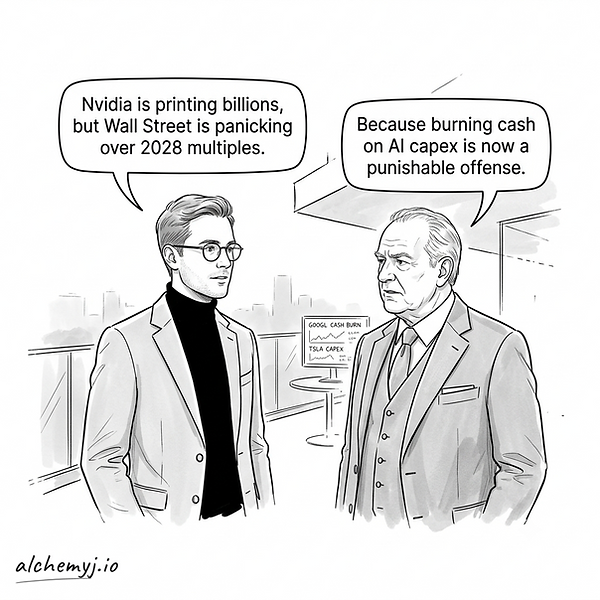
Analysis: Technology equities experienced broad market downside as the NASDAQ Composite fell between 2% and 2.35% (holding above the 25,000 threshold) to reach its lowest price point since early May, dragging the overall tech sector down 1%. Specialized funds registered sharp declines, with the Magnificent 7 ETF (MAGS) dropping 4.6% and the ARK Innovation ETF falling 3%. Software equities closed in red territory, including SHOP (Shopify) (-5%), ORCL (Oracle) (-4%), Amazon (-4.5%), Meta (-3%), NOW (ServiceNow) (~-3%), CRM (Salesforce) (~-3%), and PANW (Palo Alto Networks) (~-3%). However, CFRA Research analyst Angelo Zino notes that semiconductor pullbacks represent profit-taking following parabolic upward moves rather than fundamental weakness. Forward valuation multiples reflect significant risk discounting, with Nvidia trading at 12–13x calendar year 2028 estimated earnings, AVGO (Broadcom) at 14x, and Micron at roughly 5x.
Outlook: Capital markets exhibit sensitivity toward near-term capex returns and temporary cash flow compression, driving a divergence between depressed equity valuation multiples and underlying operational demand across hardware providers.
Capital Allocation Divergence and Regional Resilience
Analysis: Equity markets penalized companies reporting heavy capital outlays and cash burn (such as Tesla dropping 14.2% to yearly lows and Alphabet falling ~7%), while rewarding firms delivering operational beats and margin expansion, evidenced by Intel surging 11% to 12% in after-hours trading following a 25% revenue surge to $16.13 billion and gross margins reaching 41.8%. Tactical regional resilience was visible in the Korean Equity ETF (EWY), which outperformed due to heavy exposure to memory chip leaders Samsung and SK Hynix. Individual names like SpaceX (+2.5% off lows) and Applied Materials also logged gains.
Outlook: Investors are differentiating between cash-depleting infrastructure spenders and high-margin hardware enablers, favoring companies with clear pricing power or margin recovery potential (such as Intel projecting multi-year earnings power above $5 per share against TSM (TSMC)'s mid-60s and AMD's mid-to-high 50s gross margin benchmarks).
Weekly In-Depth Analysis:
→ Read Weekly TechTrends:Google’s cash drain makes tech’s huge AI spend hard to justify
Important Disclaimer
This newsletter is for informational purposes only and does not constitute investment advice. Content is generated by AI and may contain inaccuracies; always verify data independently before trading. Investing involves significant risk of loss. AlchemyJ is not a registered financial advisor. By reading this, you agree to our terms.
