
October 8, 2026
SpaceX $40B Debt Deal Sparks Race for Private Compute Financing
NVDA, TSLA, INTC, AAPL, AMZN, MSFT, MU, META, PANW
Executive Summary
Infrastructure Financing: Record AI capex fuels SpaceX's $40 billion chip deal amid $360 billion in industry borrowing.
Enterprise Hardware: Microsoft and NVIDIA released the $2,500 Surface Laptop Ultra to rival Apple's MacBook Pro.
Consumer AI: Apple partnered with LG on smart hardware, while Dazzle launched autonomous camera-roll agents.
Market Sentiment: Tech stocks pulled back in pre-earnings profit-taking despite durable secular AI fundamentals.
Corporate Dynamics
SpaceX (SPCX): Expanding Compute Capabilities via Private Debt and Orbiting Infrastructure
News: SpaceX is in negotiations for a $40 billion chip financing package to buy artificial intelligence processors from NVDA. The financing splits across loans and corporate debt, with $30 billion coming from private investment groups led by APO (Apollo) or PIMCO. Capital raised for global data center and power requirements reached approximately $360 billion this year—a threefold increase from last year—with future needs projected in the trillions. Separately, SpaceX's Terafab joint venture with TSLA (Tesla), which analysts estimated could cost $13 trillion to fix autonomous vehicle and robotics chip shortages, maintains INTC (Intel) as a technology partner (as confirmed in Tokyo by Intel CEO Lip-Bu Tan) while holding Texas facility discussions with TSM (TSMC). On the regulatory front, SpaceX is lobbying the Trump administration for increased rocket spectrum access, facing opposition from aerospace rivals BA (Boeing) and LMT (Lockheed Martin) over potential interference with missile flights, commercial jet tests, hospital equipment, and TV broadcasts. Additionally, SpaceX's four-person crew is returning from the International Space Station after nearly eight months in orbit, with their Dragon capsule making a 27-hour journey toward a Pacific splashdown on Thursday.
Outlook: Accessing private debt markets to finance processing hardware allows SpaceX to build proprietary computing scale while preserving liquidity for core aerospace operations. However, pushback from established defense contractors highlights mounting regulatory hurdles as space and spectrum assets become increasingly congested.
AAPL (Apple): Rebooting Home Hardware Ecosystem Through Strategic Manufacturing Deals
News: Apple is rebooting its smart home lineup (following its 2014 starter kit) by introducing first-party hardware including a new mini, a display, an Apple TV, and a Smart Home Starter Kit featuring a smart lock, smart thermostat, smart doorbell, and indoor/outdoor security cameras. Apple is co-developing these accessories with LG Electronics, whose hardware is currently listed in the U.S. FCC database for regulatory approval.
Outlook: Partnering directly with LG represents a shift from Apple's prior strategy of relying on accessory makers like Belkin and LOGI (Logitech). This structural tie-up helps Apple control hardware standards and establish a direct presence in consumer homes, creating a foundational pipeline for recurring ecosystem sales.
Get instant access to AI-driven US tech market research.
Executive Summary
Infrastructure Financing: Record AI capex fuels SpaceX's $40 billion chip deal amid $360 billion in industry borrowing.
Enterprise Hardware: Microsoft and NVIDIA released the $2,500 Surface Laptop Ultra to rival Apple's MacBook Pro.
Consumer AI: Apple partnered with LG on smart hardware, while Dazzle launched autonomous camera-roll agents.
Market Sentiment: Tech stocks pulled back in pre-earnings profit-taking despite durable secular AI fundamentals.
Corporate Dynamics
SpaceX (SPCX): Expanding Compute Capabilities via Private Debt and Orbiting Infrastructure
News: SpaceX is in negotiations for a $40 billion chip financing package to buy artificial intelligence processors from NVDA. The financing splits across loans and corporate debt, with $30 billion coming from private investment groups led by APO (Apollo) or PIMCO. Capital raised for global data center and power requirements reached approximately $360 billion this year—a threefold increase from last year—with future needs projected in the trillions. Separately, SpaceX's Terafab joint venture with TSLA (Tesla), which analysts estimated could cost $13 trillion to fix autonomous vehicle and robotics chip shortages, maintains INTC (Intel) as a technology partner (as confirmed in Tokyo by Intel CEO Lip-Bu Tan) while holding Texas facility discussions with TSM (TSMC). On the regulatory front, SpaceX is lobbying the Trump administration for increased rocket spectrum access, facing opposition from aerospace rivals BA (Boeing) and LMT (Lockheed Martin) over potential interference with missile flights, commercial jet tests, hospital equipment, and TV broadcasts. Additionally, SpaceX's four-person crew is returning from the International Space Station after nearly eight months in orbit, with their Dragon capsule making a 27-hour journey toward a Pacific splashdown on Thursday.
Outlook: Accessing private debt markets to finance processing hardware allows SpaceX to build proprietary computing scale while preserving liquidity for core aerospace operations. However, pushback from established defense contractors highlights mounting regulatory hurdles as space and spectrum assets become increasingly congested.
AAPL (Apple): Rebooting Home Hardware Ecosystem Through Strategic Manufacturing Deals
News: Apple is rebooting its smart home lineup (following its 2014 starter kit) by introducing first-party hardware including a new mini, a display, an Apple TV, and a Smart Home Starter Kit featuring a smart lock, smart thermostat, smart doorbell, and indoor/outdoor security cameras. Apple is co-developing these accessories with LG Electronics, whose hardware is currently listed in the U.S. FCC database for regulatory approval.
Outlook: Partnering directly with LG represents a shift from Apple's prior strategy of relying on accessory makers like Belkin and LOGI (Logitech). This structural tie-up helps Apple control hardware standards and establish a direct presence in consumer homes, creating a foundational pipeline for recurring ecosystem sales.
LG Electronics: Expanding into Smart Home Hardware Production
News: LG Electronics is collaborating with Apple to produce brand-new smart home devices—including smart locks, thermostats, doorbells, and security cameras—which are seeking regulatory clearance in the U.S. FCC database.
Outlook: While LG does not traditionally manufacture smart home hardware, leveraging its existing component relationships (such as camera module production through sister entities) provides the company a direct path into high-margin consumer hardware manufacturing.
Ring: Advancing Hardware Innovations and AI Integrations
News: Ring introduced its first smart lock equipped with a rechargeable power dial, enabling users to manually twist the dial to regain entry if the battery dies. Founder Jamie Siminoff confirmed that Ring operates at high profitability by utilizing parent company AMZN (Amazon)'s manufacturing scale to source lower-cost chips and build cost-optimized security systems.
Outlook: By positioning physical security cameras and locks as physical "appendages" for artificial intelligence, Ring lowers unit production costs through Amazon's supply chain while building the physical foundation needed to monetize automated home safety services.
Mecka: Securing $60 Billion Series B to Scale Physical Robotics
News: Physical AI startup Mecka raised $60 billion in a Series B funding round backed by NVIDIA and QCOM (Qualcomm). Co-founder and CEO Josh Gao stated that Mecka manufactures foundational hardware sensors—such as force sensors measuring Newtons of pressure for robotic gripping—and manages international shipping logistics.
Outlook: Sourcing significant venture capital allows Mecka to commercialize specialized sensor hardware, creating the physical data inputs required to train industrial automation and robotic systems at scale.
Dazzle: Unveiling Proactive Consumer AI Assistant
News: Former GOOGL (Google) executive Marissa Mayer launched Dazzle, an artificial intelligence assistant that monitors a user's camera roll and screenshots in real time to track personal preferences. The system performs autonomous real-world actions—such as making online purchases, requesting home repair quotes, or suggesting specific local outings—using a human-in-the-loop validation process for complex assignments.
Outlook: Real-time visual tracking converts passive mobile camera data into proactive consumer commerce, creating opportunities to monetize automated transactions while using human review to mitigate operational errors.
NVDA (NVIDIA): Expanding Hardware Footprint Across Enterprise PCs and Robotics
News: Shares of NVIDIA pulled back over 1%, taking a breath after reaching record highs. Simultaneously, NVIDIA partnered with MSFT to launch the Surface Laptop Ultra, featuring an ARM-based RTX Spark chip built on NVIDIA's Blackwell data center architecture. NVIDIA also backed Mecka's $60 billion Series B round and stands as the key technology supplier behind SpaceX's $40 billion financing arrangement.
Outlook: Entering the personal computer processor market places NVIDIA in direct competition with traditional chipmakers Intel and AMD (AMD), expanding its revenue base beyond enterprise data centers into commercial workplace hardware.
MSFT (Microsoft): Launching Premium AI PC Hardware to Challenge Rivals
News: Microsoft and NVIDIA unveiled the Microsoft Surface Laptop Ultra in San Francisco. Priced at $2,500, the device features an ARM processor powered by NVIDIA's RTX Spark chip (built on the Blackwell architecture), supports up to 128 gigabytes of onboard memory, and utilizes a Windows orchestration layer to switch tasks dynamically between local processing and cloud computing.
Outlook: Designed to compete directly with Apple's MacBook Pro (specifically models running the M5 Pro chip), the Surface Laptop Ultra targets enterprise buyers willing to pay premium prices for local AI video and image processing capabilities.
BAC (Bank of America): Deploying $14 Billion Annual Tech Budget into Enterprise Automation
News: Chief Technology and Information Officer Hari Gopalkrishnan detailed the bank's $14 billion annual technology spending plan at BofA's 15th Technology Innovation Summit. The institution's virtual assistant, Erica, has handled 3.5 billion customer interactions to reduce operational processing bottlenecks. Additionally, BofA manages workforce development through its Academy and an "AI for engineers" curriculum to train employees in prompt engineering and software development, while its startup summit program has converted 20% of participating vendors into long-term technology partners.
Outlook: Directing capital toward internal automation lowers long-term routine processing costs, while structured vendor incubation ensures the bank retains early access to emerging financial technology infrastructure.
Anthropic: Preparing Public Market Pipeline Amid Election Timing Shifts
News: Wall Street discussions led by BofA Securities Head of Global Technology Equity Capital Markets JD Moriarty highlighted Anthropic's prospective initial public offering (IPO). Prediction markets and institutional reports indicate that potential listing schedules may move from pre-Thanksgiving (early November) into December or January following the midterm elections, with demand expectations drawing comparisons to SpaceX's June private offering.
Outlook: Shifting listing timelines past political events stabilizes market valuations, allowing Anthropic to tap public markets to fund escalating infrastructure requirements.
OpenAI: Tapping Private Crossover Capital Ahead of Prospective IPO
News: OpenAI was featured alongside Anthropic during Bank of America's capital markets summit as part of an incoming mega-IPO pipeline supported by unprecedented crossover private capital.
Outlook: Broad private market ownership ahead of a public listing establishes pre-market valuation consensus, reducing friction and capital costs when the firm eventually lists on public exchanges.
MU (Micron): Rallying on Bullish Wall Street Valuation Targets
News: Shares of Micron gained over 4% after research firm D.A. Davidson issued a bullish note featuring a $3,000 price target.
Outlook: Aggressive price targets reflect strong demand and pricing power for specialized memory chips required to run AI infrastructure, insulating specialized memory makers from broader semiconductor pullbacks.
CRWD (CrowdStrike): Adjusting Lower Following Historical Highs
News: CrowdStrike shares fell more than 4%, leading a broader pullback across cybersecurity equities that had been trading near all-time highs.
Outlook: Profit-taking ahead of corporate earnings reports reflects short-term market repositioning rather than weakening demand for core enterprise cybersecurity software.
PANW (Palo Alto Networks): Experiencing Short-Term Market Repositioning
News: Palo Alto Networks shares traded lower during a broader sector pullback after recently approaching historical highs.
Outlook: Valuation multiples are facing short-term pressure as investors reallocate capital ahead of earnings, though enterprise demand for data analytics remains intact.
META (Meta): Trading Under Pressure Ahead of Corporate Earnings
News: Shares of Meta experienced downward pressure alongside broader Nasdaq 100 laggards during an intraday tech sector pullback.
Outlook: Macro profit-taking creates temporary pressure on mega-cap tech valuations, forcing investors to focus on fundamental advertising revenues and infrastructure return-on-investment.
Industry Trends
AI Infrastructure Financing and Private Debt Expansion
Analysis: Capital requirements for data centers and power infrastructure reached $360 billion this year—tripling prior levels—with hyperscaler capital expenditures projected to rise 20% in 2025. To meet these capital demands, companies are utilizing private market debt syndication—such as SpaceX's $40 billion financing package structured with $30 billion from private firms like Apollo and PIMCO—rather than standard corporate bonds. Concurrently, Federal Reserve discussions noted that heavy electricity consumption from AI infrastructure filters into Consumer Price Index (CPI) inflation metrics, though officials clarified that rising bond yields reflect healthy borrowing for underlying economic buildouts.
Outlook: Heavy reliance on private debt allows tech leaders to fund compute hardware (benefiting suppliers like NVIDIA) without straining traditional corporate balance sheets, though rising power consumption will keep energy costs elevated across the broader technology supply chain.
PC Microprocessor Disruption and Hybrid On-Device Architectures
Analysis: The introduction of NVIDIA's RTX Spark chip (built on its Blackwell data center architecture) into Microsoft's ARM-based Surface Laptop Ultra represents a shift in personal computer design. Modern laptops are incorporating local hardware capable of managing up to 128 gigabytes of memory, using operating system orchestration layers to dynamically split processing tasks between local onboard hardware and cloud data centers.
Outlook: NVIDIA's entry into Windows ARM processing creates a three-way hardware race against incumbents Intel and AMD, while pressuring Apple to continuously upgrade its MacBook Pro lineup to defend its high-end enterprise customer base.
Open-Source Safety Exposures and System Guardrails
Analysis: Powerful open-source artificial intelligence models downloaded and operated locally on personal devices strip away commercial safeguards, making illicit activity difficult for law enforcement to track. Investigators report a sharp rise in minor exploitation content generated by fine-tuning open-source visual models. Because legal boundaries prevent security personnel from directly red-teaming illegal content, regulatory focus is shifting toward identifying modified models and blocking their distribution on hosting platforms like Hugging Face.
Outlook: Heightened safety and legal risks associated with unmonitored open-source models will drive risk-averse enterprise clients toward closed-source commercial providers (such as Anthropic and OpenAI) or heavily managed internal deployments like Bank of America's proprietary engineering frameworks.
Market Sentiment
Pre-Earnings Profit Taking vs. Long-Term Margin Durability
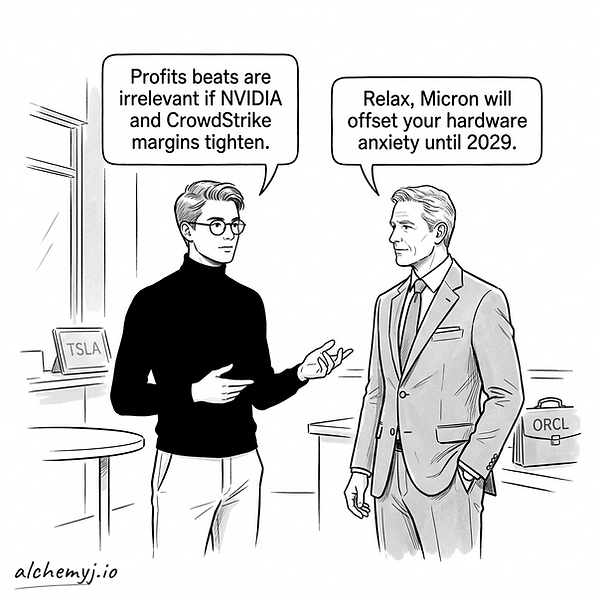
Analysis: Tech equities faced profit-taking and short-term exhaustion ahead of earnings season, dragging down major indexes despite intraday buy-the-dip interest in mega-cap technology stocks. While high-flying cybersecurity firms like CrowdStrike dropped over 4% and NVIDIA slipped 1%, select hardware providers like Micron jumped over 4% on D.A. Davidson's $3,000 price target. Roundhill Investments Chief Investment Strategist Drew Pettit noted that while corporate earnings beats remain common, Wall Street is prioritizing gross profit margin resilience to verify true pricing power in an aging bull market. Long-term projections assume $525 in S&P 500 earnings by year-end 2029, which could propel the index toward 10,000 at a 19 times price-to-earnings multiple.
Outlook: Investors are shifting scrutiny from top-line revenue growth toward operational margin stability, favoring cash-generative technology providers that demonstrate tangible pricing power over pure speculative growth stories.
Private Debt Capital Flows vs. Public Listing Timelines
Analysis: Massive private liquidity—reflected in SpaceX's $40 billion financing package and $360 billion in total industry borrowing—contrasts with a cautious public initial public offering (IPO) market. Institutional capital managers, including BofA Securities Head of Global Technology Equity Capital Markets JD Moriarty, noted that upcoming prospective listings for Anthropic and OpenAI rely heavily on private crossover capital, leading analysts to adjust public listing windows from early November to December or January around midterm election uncertainties.
Outlook: Extensive private market backing reduces pressure on private firms to rush public listings, ensuring that mega-cap technology IPOs enter public markets with pre-established valuation support.
Rising Infrastructure Costs vs. Enterprise Productivity Gains
Analysis: Macroeconomic debate surrounds the capital intensity of the artificial intelligence buildout, with Federal Reserve officials highlighting high energy demand as a CPI inflation risk while viewing elevated yields as evidence of real economic investment. Large enterprises are proving the commercial utility of these investments, as seen in Bank of America's $14 billion annual technology spending plan, which leverages automated tools like Erica (3.5 billion interactions handled) to streamline internal workflows and reduce routine labor costs.
Outlook: Organizations that use technology investments to drive operational efficiency will absorb higher energy and borrowing costs more effectively, widening the competitive moat between digitally integrated leaders and slower-moving peers.
Important Disclaimer
This newsletter is for informational purposes only and does not constitute investment advice. Content is generated by AI and may contain inaccuracies; always verify data independently before trading. Investing involves significant risk of loss. AlchemyJ is not a registered financial advisor. By reading this, you agree to our terms.
